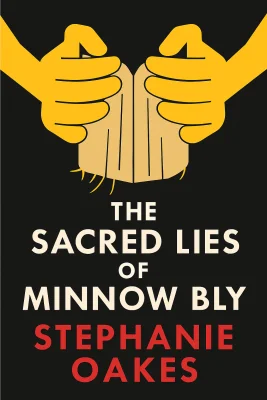
The Sacred Lies of Minnow Bly
Categories
Fiction, Horror, Mystery, Young Adult, Thriller, Contemporary, Realistic Fiction, Retellings, Cults, Mystery Thriller
Content Type
Book
Binding
ebook
Year
2015
Publisher
Dial/Penguin
Language
English
ASIN
B0DWV4KCPV
File Download
PDF | EPUB
The Sacred Lies of Minnow Bly Plot Summary
Introduction
The ruined mess of the boy's body screams down the street in an ambulance, leaving seventeen-year-old Minnow Bly standing in the frozen Montana night, her boots soaked in his blood. The cops try to handcuff her, but the metal slides off—there's nothing to cuff at the end of her arms but smooth stumps where hands once were. She doesn't scream when they squeeze the restraints around her elbows instead. After everything she's survived, physical pain means nothing. This is how Minnow's story begins in the outside world, but her real journey started years earlier in a religious cult deep in the Montana wilderness. Raised as a Kevinian under the iron grip of a self-proclaimed Prophet, she lived a life of absolute obedience until love and rebellion collided in ways that would cost her everything. Now, sitting in juvenile detention awaiting trial, she must navigate the complex truths about faith, survival, and the price of freedom while an FBI psychologist seeks answers about the mysterious fire that consumed her former home and everyone in it.
Chapter 1: Shattered Faith and Severed Hands
The hatchet comes down again and again, my father's face twisted in anguish as the Prophet screams commands from across the blood-soaked wooden floor. Each strike sends shockwaves up my arms until finally the bones snap and my hands fall away like discarded tools. The pain explodes white-hot behind my eyes, but what hurts more is watching my father—the man who taught me to count on the greyhound races, who smiled when his lucky number seven crossed the finish line—transform into this hollow puppet dancing to another man's strings. I was seventeen when they cut off my hands. The crime was simple: I refused to marry the Prophet. I had slapped his bearded face in front of the entire Community when he announced God's revelation that I would be his ninth wife. But the real transgression ran deeper. For three years, I had been sneaking away to meet Jude, a mixed-race boy whose family lived in a cabin beyond our settlement's borders. In the Prophet's twisted theology, Jude was a Rymanite—a descendant of the cursed Ryman who had defied God by marrying outside his race. Love was my rebellion. Every stolen moment in our tree house, every song Jude played on his guitar, every kiss we shared under the Montana stars was an act of defiance against the Prophet's stranglehold on our souls. But the Community of one hundred faithful souls lived by Kevin Bilson's word, believing he spoke directly to God. They called him the Prophet, this former factory worker who had convinced our families to abandon civilization for a harsh existence in the wilderness where his word was law. The Prophet kept my severed hands as trophies, mounting them on his mantelpiece like hunting prizes, the bones wired together with gold thread. In my fevered state after the amputation, I hallucinated a visit from Charlie—the human incarnation of God in Kevinian theology—but even this divine vision offered no healing, no comfort, only the crushing realization that I was truly alone.
Chapter 2: Confinement and Adaptation
They lock me in the maidenhood room to await my wedding, but my mother makes a choice that surprises us both. She appears in the doorway one night, her eyes burning with desperate fire, and dresses me in warm clothes before opening the door to freedom. "Go," she whispers. "You save yourself." It's the first time I've seen her act with such clarity since my childhood, and I realize the medications and endless pregnancies that made her seem absent were actually signs of illness, not weakness. I stumble through frozen woods to Jude's cabin, leaving a trail of blood drops from my wounds. His father Waylon, weathered by years of moonshine and grief, helps stitch my stumps while Jude holds my face in his bloodied hands and tells me stories about forest folk with magical lanterns. The pain is unbearable, but Jude's rage burns hotter. He speaks of killing the Prophet with a fury that frightens me, because I recognize that violence begets violence, and we're all capable of more brutality than we imagine. During my recovery, I learn the truth about Jude's mother. She didn't die of cancer as he'd told me—she died from a shotgun blast to the head. Jude had killed her himself, a mercy killing when her pain became unbearable and they had no way to reach medical help. The guilt has eaten at him for years, turning the gentle boy I fell in love with into someone harder, angrier, consumed by thoughts of revenge against those who hurt the innocent. As winter deepens, Jude dreams of us building a life together deeper in the wilderness, away from both the Community and civilization. But I'm changing too. The isolation that once felt like protection now feels like another prison. I've seen what happens when people retreat too far from the world—they become capable of unspeakable acts in the name of higher purposes. I love Jude, but I can't live in another cage, even one built from devotion.
Chapter 3: The Weight of Memory and Truth
The rescue mission was doomed from the start. When Jude and I returned to save my twelve-year-old sister Constance from marriage to the Prophet, we found something worse than we imagined. Constance had voluntarily had her own hands amputated to prove her devotion to the Prophet and her worthiness as his bride. The fever-bright girl lying on the pallet wasn't the innocent child I'd tried to protect—she was a true believer who saw my love for Jude as damnation. The Community had shaped Constance into their perfect saint, and she regarded me with the same horror they all did. When she screamed for help, the deacons came running. They dragged Jude to the courtyard where every person I'd grown up with formed a circle around him. The Prophet's command was simple: "Kill the Rymanite." I watched my father and the other men beat Jude to death with methodical brutality while the women covered their children's eyes and the Prophet smiled his thin, sharp smile. Even dying, Jude tried to sing our song—"Every morning, every evening, ain't we got fun?"—the melody that had carried us through our secret courtship. His voice cracked and failed as the blood filled his throat, but I finished the verse alone, sobbing over his broken body while they dragged me away. The frozen ground couldn't absorb the blood; it pooled on the surface like accusation, like evidence of what faith could justify when pushed to its extremes. They strung me up by my ankles from a tree and poured bucket after bucket of freezing pond water over me as ritual cleansing. The entire Community participated—men, women, and children each taking their turn while the Prophet chanted about purification from the sins of fornication and disobedience. But the rope was old and the knots frozen, and eventually I worked myself free. I had survived another punishment, and now I understood with perfect clarity what needed to happen next.
Chapter 4: Finding Connection in Captivity
Six months later, I sit in juvenile detention after nearly beating Philip Lancaster to death under a bridge in Missoula. The scared, mentally ill college student had approached me with his green eyes—the same color as the God I'd been taught to worship—and in my trauma-addled state, I'd mistaken him for the divine. When he grabbed my stumps, something snapped. The steel-toed boots I'd taken from Jude's cabin became weapons, and I kicked until his spleen burst and his jaw broke. My cellmate Angel is a lifer, a girl who killed her abusive uncle with five bullets to the neck. She's brilliant and hardened, reading books about neuroscience while teaching me that Carl Sagan has better explanations for the universe than any prophet. Angel becomes my guide to this new world where survival depends on different skills—reading, critical thinking, and the ability to distinguish truth from comforting lies. Dr. Wilson arrives as my FBI-appointed counselor, ostensibly to help with my mental health but actually seeking answers about the fire that destroyed the Community. He's different from what I expected—patient, thoughtful, carrying his own grief over a son killed in a car accident he'd bought for the boy's sixteenth birthday. Our sessions become a careful dance around the truth as he tries to solve the Prophet's murder while I protect the real killer. Through reading classes with Miss Bailey, I discover I have a hunger for knowledge that the Community tried to starve. Each word I decode is an act of rebellion against those who kept me ignorant. When Angel takes me to the jail roof to watch meteor showers, she explains that we're all made of exploded stars. The revelation is more beautiful and terrible than any religious doctrine—we are literally stardust, connected to the cosmos in ways the Prophet never imagined.
Chapter 5: Unraveling the Prophet's Death
Dr. Wilson pieces together fragments of the truth like a detective story. He knows the Prophet died before the fire started, suffocated during an asthma attack while his house burned around him. The investigation focuses on suspects with motive—my father, other Community members who might have finally seen through the Prophet's lies. But Wilson keeps circling back to me, sensing I hold the key to solving the mystery. The night of the fire, I had escaped my bonds and crept into the Prophet's house to retrieve my severed hands from his mantelpiece. I found him struggling for breath, reaching desperately for the asthma inhaler he'd claimed God had healed him from needing. The man who had preached about divine healing was just another liar gasping for air on his bedroom floor. When he begged me to help him reach his medicine, I looked down at my handless arms and said, "I'm sorry. I can't reach it. I haven't got hands." But the real killer wasn't me—it was Waylon, Jude's father, mad with grief over his son's murder. I found him in the courtyard after the Prophet died, throwing Molotov cocktails made from his moonshine onto every house roof. The entire Community burned that night, families fleeing into the snow as their wooden world collapsed. Constance died trying to rescue the Prophet from his flaming house, crushed when the roof caved in around her. Wilson suspects the truth but needs my confession to close the case. He shows me evidence that my father attempted suicide when questioned, unable to bear the weight of everything he'd done in the Prophet's name. The wives are scattered now, some clinging to their faith while others embrace the freedoms they'd been denied. The children are learning to live in a world with electric lights and running water, their old beliefs crumbling like the ash of their former home.
Chapter 6: The Cost of Freedom and Truth
The juvenile detention system offers me an unexpected gift—the Bridge Program, a chance at college and a real future if I can earn parole on my eighteenth birthday. Angel, facing forty years for her uncle's murder, secretly filled out my application because she believes in second chances even if she'll never get one herself. Her essay on my behalf speaks of hope surviving despite everything, of dreams that couldn't be killed even by prophets and hatchets. Dr. Wilson finally shows me the depth of his own pain when he reveals that his son Jonah died in the car he'd bought for him against his wife's wishes. The guilt drove Wilson to volunteer for this assignment, seeking redemption through helping me when he couldn't save his own child. In a gesture that could cost him his career, he breaks into evidence storage and has my severed hands cast in silver, returning them to me as a symbol that some things can be reclaimed. During a community service trip picking pears in an orchard, I encounter Jude alive but broken, living in a cave and subsisting on stolen fruit. He bears the scars of that night in the Community—his nose healed crooked, his body twisted from untreated injuries. He begs me to run away with him, to build a life in the wilderness, but I finally understand that love alone isn't enough. He wants to preserve our past; I need to discover my future. The parole hearing approaches, and I must decide whether to protect Waylon by keeping his secret or tell Wilson the truth about that night. Angel's friendship has taught me about loyalty and sacrifice, while Dr. Wilson represents the possibility that some authority figures actually want to help rather than control. The choice between justice and mercy, between truth and protection, mirrors every difficult decision that brought me to this moment.
Chapter 7: Reclaiming Identity Beyond the Flames
On the morning of my eighteenth birthday and parole hearing, I finally tell Dr. Wilson the complete truth about the Prophet's death and Waylon's revenge. I describe watching the man who claimed divine healing die from the very illness he'd pretended to cure, gasping for medication while I stood handless and helpless. I reveal how Waylon burned down the Community in grief-maddened justice, how Constance died still believing in the Prophet's lies, how sometimes the innocent suffer for the crimes of those who claim to protect them. The truth sets me free in ways I never expected. The parole board grants my release, and I'm accepted into the Bridge Program with a chance to attend college and build an independent life. Dr. Wilson keeps his promise to recommend my freedom, understanding that some truths are worth the risk. Waylon disappears into the Montana wilderness, and Wilson seems content to let the case grow cold—sometimes justice means allowing broken people to find their own peace. Angel and I share a final moment on the jail roof, shouting "FUCK!" at the unfairness of it all before saying goodbye. She's taught me that questioning everything is the only way to avoid becoming another victim of beautiful lies. From Benny, I've learned that books are weapons against ignorance. From Miss Bailey, that education is a kind of healing. These relationships, forged in confinement, prove that connection is possible even in the darkest places. As I prepare to leave juvenile detention with my silver hands gleaming in their box, I carry the weight of everything I've lost and learned. Jude waits for me in the wilderness, offering a love that would require abandoning the world again. But I choose a different path—toward cities and universities, toward questions without easy answers, toward a future where I can be more than anyone ever imagined possible.
Summary
Minnow Bly's journey from cult survivor to educated young woman reveals how the human spirit can endure unimaginable cruelty and still choose hope over bitterness. Her severed hands become symbols not just of what was taken from her, but of her refusal to remain a victim. The Prophet's death brings no satisfaction because revenge cannot resurrect the dead or restore lost innocence, but it does end the cycle of abuse that might have claimed future generations. In juvenile detention, surrounded by other damaged girls, Minnow discovers that true faith lies not in blind obedience but in the courage to question, to learn, and to keep reaching for something better. The real victory isn't in escaping one prison only to enter another, but in developing the tools to recognize the difference between protection and control, between love and possession, between truth and comfortable lies. Minnow chooses the uncertain freedom of an authentic life over the false security of isolation, whether in the Community or in Jude's cave. Her silver hands catch the light as she steps toward a future she'll write herself, no longer the handless girl who couldn't fight back, but a young woman who understands that the most powerful weapon against tyranny is an educated mind willing to ask dangerous questions.
Best Quote
“Jude taught me what love was: to be willing to hold on to another person's pain. That's it.” ― Stephanie Oakes, The Sacred Lies of Minnow Bly
Review Summary
Strengths: The review highlights the book's gripping nature from the first chapter, its well-balanced portrayal of a religious cult, and its powerful, atmospheric writing. The combination of horrific and beautiful imagery is praised, as well as the book's ability to provoke thought on religion, freedom, and justice. The narrative structure, using flashbacks and present-day events, effectively builds suspense and mystery. Overall: The reviewer expresses a highly positive sentiment, recommending the book for its ability to engage and evoke strong emotions. The novel is described as both heart-pounding and thought-provoking, with moments of humor and lightness amidst its darker themes.
About Author

Stephanie Oakes
Oakes delves into the complexities of identity and societal norms in her young adult fiction, engaging readers with themes of resistance and self-discovery. By exploring oppressive systems, particularly within religious cults and dystopian settings, her work pushes audiences to question conformity. Her debut novel, "The Sacred Lies of Minnow Bly", inspired by the Grimm fairy tale "The Handless Maiden", illustrates a girl’s escape from a cult and was both a Morris Award finalist and a Golden Kite Honor book. Meanwhile, her book "The Arsonist" delves into the mystery surrounding a historical murder, earning the Washington State Book Award and recognition as an ALA/YALSA Best Fiction for Young Adults. These narratives reflect her profound interest in the psychological and social dynamics of control and freedom.\n\nOakes’s writing style is informed by her MFA in poetry, lending a lyrical quality to her dark and intense storytelling. This distinctive voice effectively addresses sensitive subjects, offering readers insights into contemporary social issues like conversion therapy, as seen in her novel "The Meadows". The author balances her literary career with a professional role as a library media teacher, enriching her understanding of young audiences and enhancing the impact of her narratives. Through her works, Oakes provides a compelling exploration of individuality and resistance, making a significant contribution to the young adult genre. Her bio highlights her residence in Spokane, Washington, where she lives with her wife and family, underscoring a personal connection to the themes of identity and belonging that permeate her work.
Read moreDownload PDF & EPUB
To save this Black List summary for later, download the free PDF and EPUB. You can print it out, or read offline at your convenience.

The Sacred Lies of Minnow Bly
by Stephanie Oakes
