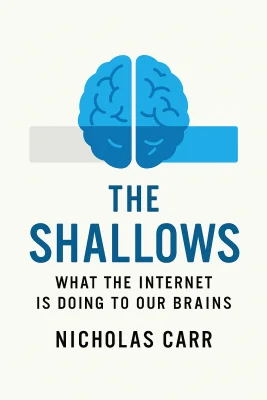
The Shallows
What the Internet Is Doing to Our Brains
Categories
Nonfiction, Self Help, Psychology, Science, Education, Technology, Audiobook, Sociology, Neuroscience, Internet
Content Type
Book
Binding
Paperback
Year
2011
Publisher
W. W. Norton & Company
Language
English
ASIN
0393339750
ISBN
0393339750
ISBN13
9780393339758
File Download
PDF | EPUB
The Shallows Plot Summary
Introduction
Digital technology has fundamentally altered how humans process information, yet we rarely pause to examine what this transformation means for our cognitive abilities. The central argument presented challenges the widely held belief that internet use simply makes us more efficient thinkers, proposing instead that our digital tools are rewiring our brains in ways that diminish our capacity for deep, contemplative thought. This neurological reshaping represents not merely a change in how we access information, but a fundamental alteration in how we think, remember, and understand the world around us. The analysis draws upon neuroscientific research, historical precedent, and philosophical inquiry to build a compelling case that our always-connected digital environment is training our minds to crave constant stimulation while weakening our ability to focus sustained attention on complex ideas. By tracing how previous technologies like the alphabet, printing press, and mechanical clock shaped human consciousness, the investigation reveals that our current digital revolution follows a similar pattern of cognitive trade-offs, where gains in one area come at the expense of capacities we may not fully appreciate until they're gone.
Chapter 1: Our Plastic Brain: The Science of Neural Adaptation
The human brain possesses a remarkable capacity called neuroplasticity, which allows it to reorganize itself throughout our lives by forming new neural connections and pathways. This discovery overturned decades of scientific orthodoxy that viewed the adult brain as fixed and unchangeable. Modern neuroscience reveals that our brains are constantly rewiring themselves based on our experiences, behaviors, and the tools we use. Every time we repeat an action or thought pattern, we strengthen certain neural circuits while allowing others to weaken and fade away. Research with London taxi drivers provides compelling evidence of this adaptability. Brain scans revealed that drivers who navigated the city's complex street network for years had significantly larger posterior hippocampi—the brain region responsible for spatial memory—compared to average individuals. The longer they had been driving, the more pronounced this enlargement became. However, this expansion came at a cost: other areas of their hippocampus actually shrank, potentially affecting different types of memory formation. Similar plastic changes occur when we learn to read, use tools, or engage with technology. Monkeys trained to use pliers to gather food showed remarkable neural adaptation, with the tools eventually becoming incorporated into their brain maps as extensions of their own limbs. These findings demonstrate that our brains don't simply use tools—they adapt to become more like the tools we use regularly. The implications extend far beyond individual brain changes. When we consistently engage with technologies that demand rapid attention-switching and fragmented focus, we're training our neural circuits to excel at these behaviors. The brain follows a "use it or lose it" principle: pathways that fire together wire together, while unused connections weaken. Our increasing reliance on digital technologies is thus sculpting our minds at the most fundamental biological level, determining which cognitive abilities flourish and which atrophy. This neuroplasticity represents both humanity's greatest strength and its potential vulnerability. While it allows us to adapt to new technologies and environments, it also means we can lose valuable cognitive abilities if we don't consciously work to maintain them. The brain's remarkable flexibility becomes a double-edged sword in our digital age.
Chapter 2: The Deepening Page: How Reading Transformed Human Cognition
The development of reading represents one of the most profound transformations in human cognitive history. Unlike speech, which evolved naturally, reading is an artificial skill that requires extensive neural rewiring. When humans learned to decode written symbols, they fundamentally altered their brain architecture, developing new neural pathways that connected visual processing centers with language regions in unprecedented ways. Early forms of writing placed enormous cognitive demands on readers. Ancient texts lacked spaces between words, punctuation, or standardized word order, making reading a laborious process of problem-solving rather than fluid comprehension. Readers had to slowly parse continuous strings of letters, often reading aloud to help decode meaning. This mental effort engaged multiple brain regions simultaneously, creating a rich network of neural connections. The introduction of word spacing and punctuation during the Middle Ages revolutionized reading by reducing cognitive load. These innovations allowed readers to process text more efficiently, freeing mental resources for deeper interpretation and reflection. For the first time in human history, silent reading became possible on a large scale, enabling the private, contemplative engagement with ideas that became the foundation of literary culture. Deep reading cultivated a particular kind of mind—one capable of sustained attention, complex reasoning, and rich associative thinking. When readers immersed themselves in long texts, they developed neural pathways optimized for focused concentration and abstract thought. The linear progression through pages of text trained the brain to follow extended arguments, build complex mental models, and engage in what we now recognize as critical thinking. This transformation wasn't merely individual but cultural. The spread of literacy created new forms of knowledge transmission, intellectual discourse, and creative expression. Writers began crafting increasingly sophisticated works, knowing they could expect readers capable of following intricate plots, nuanced arguments, and subtle stylistic variations. The symbiotic relationship between readers and writers drove the evolution of language itself, expanding vocabulary and creating new possibilities for human expression. The reading brain represents humanity's adaptation to a revolutionary intellectual technology. Just as our ancestors' brains adapted to tools for hunting and farming, literate humans developed neural architecture specialized for processing symbolic information in linear, sequential patterns. This cognitive architecture became the foundation for scientific thinking, philosophical inquiry, and artistic creation in literate civilizations.
Chapter 3: A Medium of the Most General Nature: The Internet's Unique Power
The Internet represents something unprecedented in human history: a truly universal medium capable of absorbing and redistributing virtually every form of information. Unlike previous technologies that served specific purposes, the Internet functions as what computer scientists call a "Turing machine"—a device capable of simulating any other information-processing system. This universality means that all other media inevitably flow into its digital stream, where they undergo fundamental transformation. When traditional media migrate online, they don't simply change platforms—they acquire new characteristics that alter how we experience their content. Text becomes searchable and linkable, images become interactive, and all content becomes embedded in a context of infinite connectivity. A digital book isn't just a book in electronic format; it's a book surrounded by hyperlinks, advertisements, social media feeds, and countless other digital stimuli competing for attention. The Internet's multimedia nature creates an environment of continuous partial attention, where users constantly monitor multiple information streams simultaneously. Unlike traditional media that demanded focused engagement—you read a book, listened to a radio program, or watched a television show—online media encourage rapid switching between different types of content. This fundamental shift in attention patterns has profound implications for how we process and retain information. The economics of the Internet amplify these effects. Digital platforms profit from user engagement, creating powerful incentives to capture and hold attention through constant updates, notifications, and new content. The business model depends on keeping users clicking, scrolling, and consuming ever-increasing amounts of information at ever-increasing speeds. This creates what might be called an "attention economy" where our cognitive resources become the primary commodity being harvested and sold. The Internet's speed and efficiency in delivering information creates a feedback loop that reinforces our preference for quick, easily digestible content. As we become accustomed to finding answers instantly, we lose patience with the slower rhythms of contemplative thought. The medium's emphasis on speed and efficiency gradually trains us to expect immediate gratification from all our intellectual activities. This transformation represents more than a change in how we access information—it constitutes a fundamental shift in our relationship with knowledge itself. The Internet doesn't just provide us with new tools for thinking; it provides us with new patterns of thinking that mirror its own characteristics: rapid, associative, and constantly shifting.
Chapter 4: The Juggler's Brain: Attention, Memory, and Cognitive Overload
Modern neuroscience reveals that the human brain has strict limits on its information-processing capacity, particularly in working memory—the mental workspace where we consciously manipulate thoughts and ideas. This cognitive bottleneck can handle only a few pieces of information simultaneously before becoming overwhelmed. When we exceed these limits, our ability to think deeply and form lasting memories deteriorates dramatically. The Internet's design runs directly counter to these cognitive constraints. Online environments present multiple streams of information simultaneously: text, images, videos, hyperlinks, advertisements, and notifications all compete for our limited attentional resources. Each element demands mental processing power, leaving fewer resources available for the deep thinking required to understand complex ideas or form lasting memories. Research demonstrates that people reading hypertext show significantly less comprehension and retention than those reading linear text. The cognitive effort required to evaluate links, make navigational decisions, and process multimedia content creates a state of continuous mental overload. Even when hyperlinks aren't clicked, their mere presence reduces reading comprehension by forcing the brain to make continuous decisions about whether to follow them. Multitasking, often celebrated as a valuable skill in our digital age, actually impairs learning and memory formation. When we attempt to perform multiple cognitive tasks simultaneously, the brain must constantly switch between different neural networks, incurring "switching costs" that degrade performance on all tasks. Studies show that people who multitask frequently become less able to filter irrelevant information and more susceptible to distraction even when attempting to focus on single tasks. The Internet's constant stream of notifications and updates keeps our brains in a state of heightened alertness, perpetually scanning for new information rather than settling into the calm focus required for deep thinking. This hypervigilant state may enhance our ability to rapidly process multiple information streams, but it comes at the cost of our capacity for contemplation, reflection, and the formation of rich associative memories. The juggler's brain—constantly keeping multiple information streams in motion—becomes highly efficient at certain types of cognitive work while losing proficiency in others. We develop enhanced abilities for visual processing, quick decision-making, and rapid information scanning, but we sacrifice our capacity for sustained attention, deep analysis, and the patient development of complex thoughts. This cognitive trade-off represents a fundamental shift in human mental capabilities.
Chapter 5: The Church of Google: Efficiency as the Supreme Value
Google's approach to information organization embodies the principles of scientific management that Frederick Taylor introduced to industrial production a century ago. Just as Taylor sought to optimize factory efficiency through precise measurement and algorithmic control, Google applies similar principles to the realm of human knowledge and intellectual activity. The company's engineering-driven culture treats information as raw material to be processed with maximum efficiency, viewing human attention as a resource to be optimized rather than a capacity to be nourished. The Google search algorithm represents the ultimate expression of Taylorist thinking applied to intellectual work. By analyzing millions of data points about user behavior, the company continuously refines its systems to deliver information faster and more efficiently. Every element of Google's interfaces undergoes rigorous testing, with algorithms determining optimal colors, layouts, and response times based purely on statistical measures of user engagement. This approach treats human thinking as a mechanical process that can be optimized through better inputs and faster processing. Google's business model creates powerful incentives to accelerate the pace of information consumption. The company profits when users click through multiple pages and view multiple advertisements, creating a direct financial interest in reducing the time people spend contemplating any single piece of information. The faster users move through content, the more opportunities Google has to collect data about their preferences and serve them targeted advertisements. The company's ultimate vision extends beyond search to the creation of artificial intelligence that could eventually replace human thinking altogether. Google's founders have explicitly described their goal as building systems that are "smarter than people," viewing human intelligence as a computational problem to be solved rather than a capacity to be enhanced. This reductionist view treats the human mind as simply an inefficient biological computer that could be improved through technological augmentation. Google's influence extends far beyond its own products. The company's emphasis on speed, efficiency, and algorithmic optimization has become the dominant paradigm for how we think about information processing in the digital age. Other technology companies have adopted similar approaches, creating an entire ecosystem of applications designed to accelerate the pace of human intellectual activity. The deeper concern isn't Google's power as a company but the intellectual ethic it promotes and embodies. By treating efficiency as the supreme value in intellectual work, Google's approach marginalizes other important aspects of human cognition: contemplation, reflection, patience, and the gradual development of complex understanding. The company's success in optimizing information delivery has created a model that other organizations feel compelled to follow, spreading its mechanical approach to thinking throughout digital culture.
Chapter 6: Memory and Knowledge: What We Lose When We Outsource Thinking
Human memory differs fundamentally from computer storage in ways that have profound implications for learning and understanding. While computer memory stores discrete bits of information in fixed locations, biological memory is dynamic, associative, and continuously changing. Every time we recall a memory, we reconsolidate it, potentially altering its content and connections. This organic process allows memories to grow richer and more nuanced over time, forming the complex web of associations that constitutes genuine knowledge. The process of committing information to long-term memory requires sustained attention and repetition, creating neural pathways that become stronger with use. When we memorize facts, ideas, or experiences, we don't simply store them—we integrate them into our existing knowledge structures, creating new connections and insights. This consolidation process transforms raw information into personal understanding, making it available for creative recombination and original thought. The Internet's vast databases offer unprecedented access to information, but this external storage cannot replicate the integrative functions of human memory. When we outsource our memory to digital devices, we lose the opportunity to build the rich internal knowledge structures that support deep thinking. Information that remains external never becomes truly "ours" in the sense of being available for the unconscious processing that generates insights and creative connections. Research demonstrates that the act of remembering itself changes the brain in beneficial ways. People with rich stores of internalized knowledge show enhanced cognitive abilities across multiple domains. Their brains develop more efficient neural networks for processing new information and making connections between disparate ideas. The effort required to memorize and recall information strengthens cognitive abilities rather than depleting them. The shift from internal to external memory storage has cultural implications that extend beyond individual cognition. When societies rely primarily on external storage systems, they risk losing the shared knowledge base that provides cultural continuity and coherence. Knowledge becomes fragmented and context-dependent rather than forming the integrated understanding that allows cultures to maintain their distinctive perspectives across generations. The Internet's impact on memory represents a qualitatively different challenge from previous information technologies. While books supplemented memory without replacing it, digital media increasingly serve as memory substitutes, reducing the incentive to internalize information. This shift may enhance our ability to access facts quickly, but it undermines the deeper cognitive processes that transform information into wisdom and understanding.
Chapter 7: Human Elements: Preserving Depth in a Culture of Distraction
The fundamental question raised by our digital transformation concerns what we value most about human intelligence and consciousness. As we increasingly delegate cognitive tasks to machines, we must decide which aspects of thinking are essential to preserve and nurture. The qualities that make human intelligence distinctive—creativity, empathy, wisdom, and the capacity for deep reflection—emerge from the slow, inefficient processes that digital technology tends to accelerate or automate away. Contemplative thinking requires a different kind of neural processing than the rapid-fire information processing optimized by digital media. Recent neuroscience research reveals that moral reasoning and empathy depend on slow neural processes that can be disrupted by constant distraction. The ability to understand complex social and psychological situations requires extended periods of focused attention that become increasingly rare in our hyperconnected environment. The cultural implications of our cognitive transformation extend beyond individual minds to encompass the entire ecosystem of human knowledge and creativity. Literature, science, philosophy, and art all emerged from traditions of sustained, focused thinking that may not survive the transition to digital culture. When writers can assume readers capable of extended attention, they create works of corresponding complexity and depth. When such readers become rare, cultural production inevitably becomes shallower and more fragmented. Educational systems face unprecedented challenges in preparing students for a world where both deep thinking and digital fluency are necessary. The temptation to embrace efficiency and speed in learning must be balanced against the need to develop capacities for concentration, reflection, and critical analysis. The question isn't whether to use digital tools in education, but how to use them in ways that enhance rather than diminish human cognitive capabilities. The path forward requires conscious choices about how we integrate digital technology into our lives. Rather than passively accepting the attention patterns that our devices encourage, we can deliberately cultivate practices that maintain our capacity for deep thinking. This might involve regular periods of disconnection, the deliberate practice of sustained reading, or the conscious choice to slow down our information consumption to allow for reflection and integration. The preservation of human cognitive depth ultimately depends on recognizing that efficiency isn't the only value worth pursuing in intellectual life. The qualities that make thinking truly human—creativity, wisdom, empathy, and understanding—often emerge from processes that appear inefficient but are essential for the full development of human consciousness.
Summary
The core insight emerging from this analysis is that our digital tools are not merely changing how we access information—they are fundamentally rewiring our brains to prioritize rapid information processing over deep contemplative thought. This neurological transformation represents a historic shift in human consciousness, comparable to the cognitive changes that accompanied the development of reading and writing, but occurring at an unprecedented pace and scale. The evidence presented demonstrates that our brains adapt to the demands of whatever tools we use most frequently, strengthening neural pathways that support the skills those tools require while allowing other capacities to atrophy. As we spend increasing amounts of time in digital environments that reward quick scanning and rapid task-switching, we lose proficiency in the sustained attention and contemplative reflection that support complex reasoning, creative insight, and deep understanding. This book offers essential reading for anyone concerned with preserving the full spectrum of human intellectual capabilities in our increasingly connected world.
Best Quote
“The Net’s interactivity gives us powerful new tools for finding information, expressing ourselves, and conversing with others. It also turns us into lab rats constantly pressing levers to get tiny pellets of social or intellectual nourishment.” ― Nicholas G. Carr, The Shallows: What the Internet is Doing to Our Brains
Review Summary
Strengths: The review highlights Nicholas Carr's balanced approach in "The Shallows," acknowledging the benefits of technology while critically examining its impact on cognitive processes through the concept of neuroplasticity. The book is praised for exploring how the brain's adaptation to technology may diminish deep thinking and specialization. Weaknesses: The review suggests a concern about the loss of specialization and the potential for misinformation, as the ease of online information dissemination can lead to superficial understanding and acceptance of unverified content. Overall: The reader expresses a thoughtful concern about the cognitive shifts induced by technology, appreciating Carr's exploration of these changes. The review indicates a recommendation for those interested in understanding the broader implications of technology on thought processes.
About Author

Nicholas Carr
Carr interrogates the intricate relationship between technology and society, shedding light on how digital advancements impact human cognition and cultural dynamics. His writing method involves critical analysis and probing questions, challenging prevailing notions of technology's role in modern life. By scrutinizing themes of digital dependency and the cultural consequences of technology, Carr's works, such as "The Shallows" and "Superbloom," offer valuable insights into the pervasive influence of the internet and social media. These books explore the human mind's response to digital stimuli, suggesting a reshaping of thought patterns and societal interactions.\n\nCarr's thoughtful critique of Silicon Valley's culture and the myths surrounding techno-utopianism serves as a lens through which readers can examine their own interactions with technology. His essays, like "Is Google Making Us Stupid?", included in renowned anthologies, echo his core theme of examining how technological tools reshape our cognitive landscape. This analytical approach benefits readers across various disciplines, from technology enthusiasts to sociologists, prompting them to reconsider the integration of digital tools in their lives and work.\n\nAs a bestselling author and a prolific contributor to leading publications, Carr bridges the gap between scholarly discourse and public understanding. His diverse contributions, spanning books and articles, enrich public conversations about technology's impact. Carr's notable recognition, including being a finalist for the Pulitzer Prize, highlights the significance of his work in today's digitally driven world. This bio of his career offers a comprehensive view of how his insights into the technological paradigm challenge us to rethink the roles digital innovations play in shaping our futures.
Read moreDownload PDF & EPUB
To save this Black List summary for later, download the free PDF and EPUB. You can print it out, or read offline at your convenience.
The Shallows
by Nicholas Carr
