
The Sirens of Titan
Categories
Fiction, Classics, Science Fiction, Fantasy, Literature, Science Fiction Fantasy, Humor, Book Club, Novels, Satire
Content Type
Book
Binding
Paperback
Year
1999
Publisher
Gollancz
Language
English
File Download
PDF | EPUB
The Sirens of Titan Plot Summary
Introduction
In a universe ruled by chaos and coincidence, a billionaire playboy named Malachi Constant received an invitation that would shatter his reality forever. The invitation came from Winston Niles Rumfoord, a man who had piloted his private spacecraft into a chrono-synclastic infundibulum – a cosmic phenomenon that spread him across time and space. Now Rumfoord existed as a wave, materializing on Earth every 59 days with his dog Kazak. As Malachi stepped through the small door in the wall of the Rumfoord estate, he had no idea he was entering the first scene of an epic that would carry him across the Solar System. Rumfoord casually informed him that he would soon travel to Mars, Mercury, back to Earth, and finally to Titan – all part of a cosmic script written by forces beyond human comprehension. The truth was more startling than fiction: every human event had been orchestrated to deliver a simple spare part to an alien messenger stranded on Titan, waiting for 200,000 years to continue his journey.
Chapter 1: The Materialization: A Billionaire's Fateful Invitation
The small door in the wall of the Rumfoord estate in Newport was only four-and-a-half feet high, made of iron and secured with a Yale lock. Beyond it stood a stone fountain, dry and abandoned, with birds' nests in its tiered bowls. Malachi Constant, the richest man in America, had received a mysterious invitation to witness Rumfoord's materialization. The guards had been diverted, allowing him exclusive access to an event normally closed to outsiders. Inside the mansion, a butler led Constant to a tiny room beneath a spiral staircase. "Skip's Museum," read a driftwood plank over shelves lined with shells, bones, and biological specimens. Winston Niles Rumfoord appeared suddenly, tall and aristocratic, exuding the easy confidence of old money and proper breeding. "They tell me you're possibly the luckiest man who ever lived," Rumfoord remarked with his distinctive glottal tenor. "I guess somebody up there likes me," Constant replied casually. Rumfoord smiled. "What a charming concept." He spoke as if he knew everything about Constant's past and future. With disturbing nonchalance, he informed Constant that he would soon travel to Mars, where he would be bred like a farm animal with Rumfoord's own wife, Beatrice. "I can read your mind, you know," Rumfoord said when he noticed Constant's discomfort. "You're not a bad sort, particularly when you forget who you are." Before Constant departed, Rumfoord showed him a photograph of three impossibly beautiful women – one white, one gold, one brown – waiting for him on Titan, Saturn's largest moon. The image stirred something primal in Constant, something beyond ordinary desire. "See you on Titan," Rumfoord's disembodied grin said before vanishing completely.
Chapter 2: Downfall and Recruitment: Memory Erased, Identity Stolen
Malachi Constant's financial empire collapsed with stunning speed. What had taken his father forty years to build, Malachi destroyed in three months of catastrophic decisions. The corporations he controlled – MoonMist Tobacco, Galactic Spacecraft, and dozens of others – all plummeted in value. Ransom K. Fern, the president of Magnum Opus, Inc., which managed Constant's affairs, delivered the news bluntly. "You've succeeded in what I would have said was impossible," Fern told him. "You've wiped out the results of almost forty years of inspired guessing." Left with nothing but crushing debt, Constant retreated to Room 223 of the Wilburhampton Hotel – the same humble room where his father had started his fortune using a bizarre investment system based on random Bible passages. There, Constant found a letter his father had instructed Fern to deliver only if disaster struck. "Something big and bad has happened to you or you wouldn't be reading this letter," it began. "Have a look around for me, boy. If you go broke and somebody comes along with a crazy proposition, my advice is to take it." That night, two strangers entered his room – a fat man called Helmholtz and a scrawny "woman" who was actually a man in disguise. They revealed themselves as agents for the Army of Mars, offering Constant a direct lieutenant-colonelcy. With Earth holding nothing but ruin for him, Constant accepted. The next day, his helicopter was found abandoned in the Mojave Desert, with footprints leading away for forty feet before vanishing entirely. Weeks later, Winston Niles Rumfoord materialized again. This time, he announced that his space ship, renamed "The Rumfoord," would launch for Mars. To the world's shock, he proclaimed that Mars was populated and recruiting an army from Earth. The machinery of destiny was now in full motion, precisely as Rumfoord had foreseen.
Chapter 3: The Martian Deception: Warfare Through Radio-Controlled Souls
Unk – formerly Malachi Constant with his memory erased – stood at attention on the iron parade ground of Mars. He was a private in the Martian Assault Infantry, a soldier whose mind had been wiped clean after multiple "treatments" at the base hospital. An antenna had been implanted in his skull, allowing his commanders to control his every movement and thought. The regiment formed a hollow square around a prisoner tied to a stake. Without emotion, the unit commander ordered Unk to strangle the man. As Unk approached, the prisoner's eyes flickered with recognition. "Unk...blue stone, barrack twelve...letter," the red-headed man gasped before Unk's thumbs closed around his throat. Later, Unk discovered a letter hidden under a blue stone outside barrack twelve. It was written to himself, by himself, before his last memory erasure. The letter revealed terrible truths: Mars was preparing to attack Earth. The Martian soldiers were all kidnapped Earthlings with cleaned memories and implanted antennas. Most shocking of all, the man Unk had just strangled was Stony Stevenson – his best friend who had been helping him piece together the truth. The hidden commander of Unk's unit was a young Black soldier named Boaz who carried a control box in his pocket. Unlike the other soldiers, Boaz had no antenna in his skull. He was one of the secret "real commanders" of the Martian Army, answering to a mysterious man who appeared with his dog every hundred days – Winston Niles Rumfoord. When the order came to board the invasion ships, Unk deserted. He searched desperately for his wife Bee, an instructress at the Schliemann Breathing School, and their son Chrono, a talented German batball player at the school. Neither recognized him. When military police captured Unk, Rumfoord appeared with his dog Kazak. "Mars is a very bad place for love," Rumfoord told him before relating the story of how Constant had forced himself on Beatrice during their journey to Mars. Their son Chrono was the result. Now the Martian Army was launching its doomed invasion of Earth – a suicide mission orchestrated by Rumfoord himself for purposes beyond Unk's comprehension.
Chapter 4: Mercury's Depths: Finding Purpose in Alien Caves
The space ship carrying Unk and Boaz wasn't headed to Earth with the rest of the Martian fleet. Instead, it descended through the atmosphere of Mercury, plunging into progressively narrower tunnels until it could go no deeper. They were trapped in a cave one hundred and sixteen miles beneath Mercury's surface. "God damn if it didn't go and set us down right in the middle of a Hollywood night club!" Boaz exclaimed, mistaking the strange yellow and aquamarine patterns on the cave walls for nightclub decorations. The patterns were created by harmoniums – flat, diamond-shaped creatures that fed on vibrations and clung to the phosphorescent walls. When they tried to take off, the ship's automatic navigator could only bash itself against the cave ceiling before returning to the floor, defeated. They were imprisoned, seemingly forever, in the silent caves of Mercury. "We're dead, Unk!" Boaz wailed. But the harmoniums formed a message on the wall: "IT'S AN INTELLIGENCE TEST!" Over the following days, new messages appeared, challenging them to solve the puzzle of escape. After a year of failed attempts, Unk saw the solution: turn the ship upside down. The sensing equipment was on the bottom of the ship; inverted, it would navigate up and out the same way it had navigated down and in. But when the time came to leave, Boaz refused to go. During their time in the caves, he had discovered something extraordinary – the harmoniums responded to music. When he played recordings for them, they rearranged themselves in beautiful patterns of color and light. For the first time in his life, Boaz had found creatures who loved him unreservedly. "I found me a place where I can do good without doing any harm," Boaz told Unk, his voice filled with newfound peace. "I found me a home." As Unk prepared to depart alone, Boaz added: "When I die down here someday, I'm going to be able to say to myself, 'Boaz – you made millions of lives worth living. Ain't nobody ever spread more joy. You ain't got an enemy in the Universe.'"
Chapter 5: The Return and Revelation: Public Humiliation on Earth
A rainy spring afternoon in West Barnstable, Cape Cod. A wild man with tangled hair and a makeshift breechclout of wrenches and copper wire emerged from the woods. This was Malachi Constant, returned from Mercury. His spacecraft had landed beside a country church – now the Church of God the Utterly Indifferent, a religion that had spread across Earth following the Martian War. The Reverend C. Horner Redwine rang the church bell madly. His congregation rushed to witness what they'd been waiting for: the prophesied arrival of the Space Wanderer. They dressed the bewildered man in a skintight yellow suit emblazoned with orange question marks, then paraded him through town on a fire engine. All along the route to Newport, crowds pelted him with flowers, cheering for a man they didn't recognize. At the Rumfoord estate, Winston Niles Rumfoord awaited on a golden scaffold. Beside him stood a dark-skinned woman with gold teeth and a sullen boy – Beatrice and Chrono, survivors of the Martian invasion who now sold religious souvenirs outside the estate's wall. "Who are you?" Rumfoord asked the Space Wanderer before the crowd. "I don't know my real name," he answered. "They called me Unk." "What happened to you before you arrived back on Earth?" "I was a victim of a series of accidents, as are we all." Then Rumfoord delivered his thunderbolt: "They called you Malachi Constant." The crowd gasped. This was the man whose effigy they hung in their homes as a symbol of greed and moral corruption. "We hate Malachi Constant," Rumfoord proclaimed, "because he accepted the fantastic fruits of his fantastic good luck without a qualm, as though luck were the hand of God!" Rumfoord explained that Constant would now board a space ship bound for Titan, taking with him "all mistaken ideas about the meaning of luck, all misused wealth and power, and all disgusting pastimes." As Constant climbed the world's tallest free-standing ladder to the waiting ship, Rumfoord revealed that Beatrice and Chrono would join him in exile. "Our hearts won't be breaking when we leave this planet," Beatrice declared defiantly. "It disgusts us at least as much as we, under your guidance, disgust it." The three boarded the ship as outcasts, sacrificial lambs for Rumfoord's new religion.
Chapter 6: Exile on Titan: Meeting the Messenger from Tralfamadore
Titan welcomed its new exiles with breathtaking beauty. The moon's skies offered an incomparable view of Saturn's rings, which the locals called "Rumfoord's Rainbow." The landscape featured three emerald seas, forests of towering trees, and fields of gigantic daisies cultivated by the moon's only other inhabitant – Salo. Salo was not human. Four and a half feet tall with tangerine-colored skin, three eyes, and three deer-like legs, he was a messenger from the planet Tralfamadore in the Small Magellanic Cloud. For 200,000 years, he had been stranded on Titan after his flying saucer broke down. He carried a sealed message that he was forbidden to open until he reached his destination, eighteen million light-years beyond Titan. Winston Niles Rumfoord, permanently materialized on Titan due to a quirk in the cosmic waves, lived in a replica of the Taj Mahal on an island in the Winston Sea. When Salo visited him after the arrival of the exiles, he found Rumfoord sickly and bitter. Sunspots were disrupting his wave pattern, causing him to fizz with Saint Elmo's fire. "Shall we just drop this guise of friendship?" Rumfoord said coldly to the messenger he once called friend. He had discovered a terrible truth: the entire history of Earth had been manipulated by Tralfamadorians to deliver a replacement part for Salo's ship – the very "good-luck piece" that Chrono carried. "Before my dog and I go crackling off through space," Rumfoord demanded, "I want you to open the message and read it to me now." Salo was torn between his programming and his friendship. After agonizing moments, he broke the seal on the message he had carried for half a million years. Inside was a single dot. In Tralfamadorian, its meaning was simple: "Greetings." Devastated by the triviality of the message that had cost so many lives, Salo fled to the beach and dismantled himself, scattering his parts across the sand.
Chapter 7: The Cosmic Joke: All Human History for a Simple Spare Part
Years passed on Titan. Malachi, Beatrice, and Chrono settled into exile, each finding their own way to exist in their strange new world. Chrono, now a teenager, ran away to live with the Titanic bluebirds, wearing their feathers and learning their language. Beatrice lived alone in Rumfoord's palace, writing a massive manuscript titled "The True Purpose of Life in the Solar System" – a refutation of Rumfoord's claim that humanity existed merely to help a stranded alien. Malachi lived in Salo's abandoned spacecraft, collecting Titanic food and tending the statues Salo had created during his long exile. Over time, a quiet respect developed between Malachi and Beatrice. When she needed help after Chrono's disturbing visits, she would signal with a white sheet, and Malachi would come. Seventy-four years old now, Malachi canoed across the Winston Sea to visit Beatrice. She read aloud from her manuscript while he cleaned the algae-choked pool. "The worst thing that could possibly happen to anybody," she said suddenly, "would be to not be used for anything by anybody." "Thank you for using me," she told Malachi, "even though I didn't want to be used by anybody." When Malachi looked up from his work, Beatrice had stopped breathing. After burying her by the Winston Sea, he returned to find Salo waiting for him – rebuilt from the parts Malachi had patiently reassembled over the years. "If you would like a ride back to Earth," Salo offered, "it wouldn't be much out of my way." Malachi, suddenly alone and with nothing to keep him on Titan, accepted. He asked to be taken to Indianapolis, having read it was "the first place in the United States where a white man was hanged for the murder of an Indian." The journey was swift. Salo, fearing for the old man's welfare, hypnotized him before landing in a snowy vacant lot. "When you know you are dying," Salo whispered, "a wonderful thing will happen to you." Malachi sat on a bench in the pre-dawn darkness, waiting for a bus that would arrive too late. As snow drifted over him, the post-hypnotic suggestion took effect. He imagined a golden space ship landing before him, piloted by his long-dead friend Stony Stevenson. "Hello, Unk," Stony said. "Get in." "And go where?" asked Malachi. "Paradise," Stony replied. "Beatrice is already there, waiting for you." As Malachi died in the Indianapolis snow, he asked one final question: "I'm going to get into Paradise?" "Don't ask me why, old sport," said Stony, "but somebody up there likes you."
Summary
The cosmic puppet show orchestrated by Tralfamadorian engineers finally reached its curtain call. Winston Niles Rumfoord, the chrono-synclastic infundibulated master of ceremonies, had vanished into the vastness of space, his elaborate scheme complete. The Martian War, the Church of God the Utterly Indifferent, the exile of Malachi Constant – all were merely scenes in a grand production designed to deliver a simple spare part across interstellar distances. And the message that justified this cosmic manipulation? A single dot meaning only "Greetings." Yet within this meaningless universe, meaning emerged anyway. Boaz found purpose bringing joy to the harmoniums of Mercury. Beatrice discovered that being used was better than being useless. And Malachi Constant, the luckiest and most unlucky man who ever lived, died believing that somebody up there liked him after all. Perhaps the greatest cosmic joke was that in a universe ruled by indifferent forces, human connections – friendship, love, compassion – still mattered. Even as puppets dancing on invisible strings, humans found ways to make their dance matter, if only to each other.
Best Quote
“A purpose of human life, no matter who is controlling it, is to love whoever is around to be loved.” ― Kurt Vonnegut, The Sirens of Titan
Review Summary
Strengths: The review highlights the novel "Sirens of Titan" as a foundational work in Kurt Vonnegut's literary career, suggesting it set the template for his future works. The reviewer appreciates its exploration of philosophical themes like fate and free will, framed within an absurdist narrative. The connection to Vonnegut's other works, such as "Slaughterhouse-Five," is noted, indicating its significance in his bibliography. Overall: The reviewer expresses deep affection for "Sirens of Titan," describing it as a transformative reading experience. The novel is highly recommended, particularly for its thematic depth and narrative style, which the reviewer finds profoundly impactful and defining.
About Author
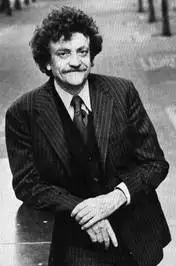
Kurt Vonnegut Jr.
Vonnegut investigates the human condition through a lens of dark humor and incisive social commentary, challenging readers to confront the absurdity of war and the search for meaning. His writing is deeply informed by personal experiences, including his capture during World War II and survival of the Dresden bombing. This trauma, alongside his Midwestern upbringing, informs his narrative style, marked by a blend of science fiction and satire. Vonnegut frequently uses nonlinear storytelling and metafictional techniques to unsettle conventional literary norms and provoke thought about free will and the inexorable passage of time.\n\nThrough novels such as "Slaughterhouse-Five" and "Cat's Cradle," Vonnegut critiques societal norms and explores existential dread, making his work both entertaining and thought-provoking. "Breakfast of Champions" further underscores his ability to critique American culture through metafictional layers. As an author, Vonnegut utilizes straightforward prose and a conversational tone to engage readers in his speculative worlds, inviting them to question reality and the fragility of human life. This approach has cemented his place in the literary canon, influencing generations of writers and readers who appreciate his unique blend of humor and critique.\n\nVonnegut's impact extends beyond his books, having been nominated for prestigious awards like the National Book Award. His legacy is celebrated through various honors, including being named Humanist of the Year by the American Humanist Association. By weaving themes of war, technology, and human dignity, Vonnegut's work remains relevant and revered, providing valuable insights into human nature that continue to resonate in contemporary discourse. His bio reflects a life dedicated to probing the complexities of existence, leaving a lasting mark on literature and culture.
Read moreDownload PDF & EPUB
To save this Black List summary for later, download the free PDF and EPUB. You can print it out, or read offline at your convenience.

The Sirens of Titan
by Kurt Vonnegut Jr.
