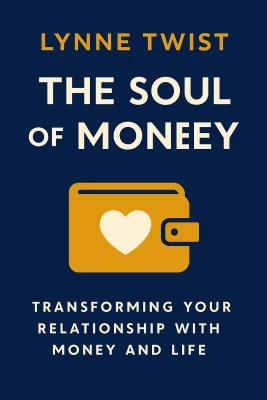
The Soul of Money
Transforming Your Relationship with Money and Life
Categories
Business, Nonfiction, Self Help, Psychology, Finance, Economics, Spirituality, Money, Personal Development, Personal Finance
Content Type
Book
Binding
Hardcover
Year
2003
Publisher
W. W. Norton Company
Language
English
ASIN
0393050971
ISBN
0393050971
ISBN13
9780393050974
File Download
PDF | EPUB
The Soul of Money Plot Summary
Introduction
Picture this: a grandmother sits by her window, watching her adult children argue over inheritance while her grandchildren play nearby, oblivious to the tension that money has created in their family. This scene unfolds in countless homes around the world, where the very thing designed to support and nurture life becomes a source of division and pain. Money touches every aspect of our existence, yet for most of us, it remains one of the most conflicted and unexamined areas of our lives. This exploration takes us on a transformative journey through the complex relationship between money and our deepest values. Drawing from decades of experience in fundraising across diverse cultures, from the boardrooms of Silicon Valley to the villages of Bangladesh, we discover that our struggles with money often reflect a profound disconnection from our authentic selves. The stories shared here reveal how individuals from vastly different circumstances have learned to align their financial choices with their soul's deepest commitments, creating lives of genuine prosperity regardless of the numbers in their bank accounts. Through intimate encounters with both the desperately poor and the incredibly wealthy, we uncover universal truths about sufficiency, generosity, and the surprising power of enough.
Chapter 1: The Great Lie of Scarcity: Dismantling Our Money Myths
In a towering Chicago skyscraper, a CEO slides a check for $50,000 across his mahogany desk. The money comes with no questions asked, no genuine interest in the cause, just a calculated move to clean up his company's tarnished reputation. Hours later, in a leaking church basement in Harlem, an elderly woman named Gertrude rises from her folding chair. "Money is a lot like water," she declares with quiet dignity. "For some folks it rushes through their life like a raging river. Money comes through my life like a little trickle. But I want to pass it on in a way that does the most good for the most folks." She walks to the front and places fifty hard-earned dollars into grateful hands. The contrast between these two transactions reveals something profound about the nature of money itself. The corporate check, despite its impressive amount, carries the weight of guilt and manipulation. Gertrude's modest contribution flows with integrity and purpose, transforming everyone it touches. Her words capture an essential truth that our culture has forgotten: money is not a static possession to be hoarded or a weapon to be wielded, but a current of energy that can carry our deepest intentions into the world. This story illuminates the three toxic myths that govern our relationship with money. First, the lie that there's not enough to go around, which drives us into competition and fear. Second, the belief that more is always better, trapping us in an endless chase that can never be won. Third, the resignation that "that's just the way it is," which keeps us imprisoned in systems that serve no one's highest good. These myths create artificial scarcity in a world of genuine abundance, turning money from a tool of connection into an instrument of separation.
Chapter 2: Sufficiency: Discovering the Power of Enough
Deep in the Sahel Desert of Senegal, where the orange sand stretches endlessly and life seems impossible, drums suddenly pierce the silence. As our vehicles approach, tiny figures on the horizon transform into dozens of children running with pure joy toward our small delegation. Under two ancient baobab trees, over a hundred people have gathered in celebration, their colorful traditional dress creating a vibrant oasis in the stark landscape. The drums beat with infectious rhythm as women pull visitors into their circle, dancing and singing with an energy that seems to defy their harsh circumstances. These were not people crushed by poverty, despite living in one of the most challenging environments on Earth. When the dancing stopped and serious conversation began, the village women shared their vision with remarkable clarity. They had seen in their dreams that water lay beneath the ground, and they needed permission from the men to dig deep enough to reach it. Their certainty was unshakable, their commitment absolute. Over the following year, through singing and drumming and caring for each other's children, they dug deeper and deeper until they reached the underground lake of their visions. The water transformed not just their village, but seventeen surrounding communities. This story reveals the essence of sufficiency – not a quantity of anything, but a way of being that recognizes the abundance already present. These women didn't need more resources; they needed to appreciate and act upon what they already had: their wisdom, their unity, their willingness to work together. Sufficiency is a context we generate, a declaration that there is enough and we are enough. When we shift from the scarcity mindset of "not enough" to the sufficiency mindset of "enough," we discover resources we never knew we possessed and possibilities we never imagined existed.
Chapter 3: Money as Water: The Currency of Connection and Contribution
The Microsoft campus in Seattle buzzes with the energy of unprecedented success. In an elegant conference room, ten accomplished women executives share their daily reality: up at 5:30 AM, online by 8:00, working until 10 PM, then back online until 1:00 AM. With an average net worth of $10 million and an average age of thirty-six, these women represent the pinnacle of financial achievement. Yet their stories reveal a different truth. Despite their wealth, they feel trapped in an endless cycle of work that leaves little time for their children, their relationships, or themselves. Their money has become a prison rather than a tool of freedom. Each woman describes the same pattern: promising to get home earlier, to be more present with their families, only to find themselves drawn back to their computers and the demanding rhythm of corporate success. Their wealth enables them to buy services – nannies, housekeepers, meal delivery – but these purchases only free them to work more hours, not to live more fully. The very thing that was supposed to create freedom has become their master. During our evening together, something shifts as these high-powered executives connect with stories of women in developing countries who, despite having only two to five dollars a day, create rich communities of mutual support and celebration. The Microsoft women begin to see their own wealth differently – not as something to accumulate endlessly, but as water that should flow through their lives toward their highest values. They start to question whether their relentless pursuit of more is actually taking them further from the lives they truly want to live. This transformation illustrates a fundamental principle: money's true power lies not in its accumulation but in its flow. Like water, money becomes toxic when it stagnates and life-giving when it moves with purpose. The quality of that flow depends entirely on the consciousness we bring to it. When we direct money toward our deepest commitments, it becomes a conduit for love and a currency of contribution.
Chapter 4: What You Appreciate Appreciates: Stories of Transformation
In the rural district of Sylhet, Bangladesh, seven friends gathered around their colleague Zilu as he shared an impossible vision. Their region was dying – the land overrun with poisonous brambles, young people turning to crime, families preparing to abandon their ancestral home. But Zilu had attended a workshop in Dhaka where he glimpsed a different possibility: a Bangladesh that contributed to the world rather than depending on handouts. His eyes blazed with conviction as he described what they could accomplish together. The other men were skeptical. The government land was worthless, covered with thorns and brambles that had defeated previous attempts at cultivation. But Zilu's appreciation for their collective strengths was infectious. One friend had natural leadership abilities, another excelled at organizing, a third could inspire anyone to action. Together, they convinced village officials to let them clear seventeen acres of the seemingly worthless land. With just $750 pooled from the community's savings, they began the backbreaking work of clearing the brambles. As they worked, singing and encouraging one another, their appreciation for the land itself began to reveal hidden treasures. Beneath the thorns, they discovered not just fertile soil but an unknown lake teeming with fish. The government, impressed by their vision and determination, granted them an additional hundred acres. Within months, the entire region was transformed. Where once there had been desperation and crime, now there were thriving farms, fish ponds, and training programs for young people. The crime rate dropped by seventy percent. This remarkable transformation demonstrates a profound truth: what we appreciate appreciates. When we focus our attention on problems and limitations, they expand and multiply. But when we consciously direct our appreciation toward existing assets and possibilities, they grow beyond our wildest imagination. The seven friends didn't find success by acquiring more resources – they found it by recognizing and nurturing the wealth that was already present in their community, their land, and themselves.
Chapter 5: Collaboration Creates Prosperity: Breaking Barriers Together
In a gas station near the Golden Gate Bridge, an exhausted woman discovers her car brakes have failed just as evening darkness falls. Through the windows of a nearby auto garage, she glimpses an unexpected scene: thirty people celebrating around a grand piano that sits in the center of the concrete floor. When she desperately explains her situation, the garage owner laughs and jokes, "Our piano player is a no-show. If you can play the piano, we'll fix your car." What begins as a lighthearted exchange transforms into something magical as music fills the garage and strangers become friends united in celebration. For nearly an hour, the stranded motorist plays piano while a mechanic cheerfully repairs her brakes and the party swirls around them. When the work is complete, the garage owner refuses payment, toasting their new friendship instead. Everyone had exactly what the situation required: she had musical talent, they had mechanical expertise, and together they created an evening that none of them would ever forget. The driver went home not exhausted and frustrated, but energized and renewed by this unexpected collaboration. This chance encounter reveals the natural abundance that surrounds us when we shift from competition to collaboration. In a scarcity mindset, we might see only problems: a stranded motorist, a party without music, a business transaction after hours. But in the context of sufficiency, these apparent limitations become opportunities for creative partnership. Each person contributed their unique gifts, and the result was far richer than any individual transaction could have provided. True collaboration creates prosperity that extends far beyond financial gain. When we recognize that everyone has valuable assets to contribute – whether money, skills, time, or wisdom – we open the possibility for authentic partnerships where all parties are enriched. This is the foundation of sustainable abundance: not the accumulation of individual wealth, but the circulation of gifts and resources that strengthens the entire community.
Chapter 6: Taking a Stand: Money as an Expression of Soul
In a grove of subabil trees in Tamil Nadu, India, sixteen women break a silence that has lasted generations. With tears streaming down their faces, they confess the terrible secret they have carried: each has killed at least one of her newborn daughters. In their culture, girls are seen as financial burdens who require costly dowries when they marry. The practice of female infanticide, while unspoken, is widely accepted as the cruel mercy of preventing a life of suffering. These women have gathered with outsiders for the first time to share their unbearable grief and their desperate desire to end this horror forever. As they wail and sob for their lost daughters, the women make a commitment that will require tremendous courage: they will draw the line at this moment and never again participate in infanticide. They will speak out against the practice, even knowing they will face ridicule from other women and harsh consequences from the men in their village. Their stand for the life of their daughters is ultimately a stand for themselves and for the sanctity of all life. The impact of their courage extends far beyond their village. Within months, famous Bollywood actors create public service announcements celebrating the value of daughters. Popular singers record songs honoring girls as the heart and soul of every family. Journalists begin reporting on this local campaign, and the message spreads throughout the state of Tamil Nadu's fifty-five million people. What began with sixteen grieving women in a tree grove becomes a movement that challenges centuries of tradition and saves countless lives. This transformation demonstrates the power of taking a stand that aligns money with soul. When we use our financial choices to express our deepest values rather than simply responding to cultural pressures, we become agents of change that ripple outward in ways we cannot imagine. Whether we direct our dollars toward companies that respect human dignity or withdraw our support from systems that demean life, every financial decision becomes an expression of who we choose to be in the world.
Chapter 7: Creating a Legacy of Enough: Living Our Values
At eighty-seven, dying of terminal cancer, a remarkable mother spends her final weeks creating a legacy that extends far beyond money. Sitting on her sun-drenched patio surrounded by the flowers she has lovingly tended, she reflects with her daughter on a life well lived. Her greatest pride is not in the possessions she has accumulated, but in the millions of dollars she raised throughout her lifetime for orphanages, museums, literacy programs, and countless other causes that touched her heart. With deliberate intention, she reaches out to acknowledge everyone who has enriched her daily life. She calls the dry cleaner, the car mechanic, the hairdresser, and the restaurant owners, telling each one how much their service has meant to her. "I'm dying and will probably be gone by September," she tells them with gentle directness. "When a person gets old and can't do a lot for herself anymore, the people in the neighborhood who provide these needed services become the people who inhabit your life, the people who make your day." She invites them all to sit with the family at her funeral. In her final generous act, she carefully prepares modest financial gifts for each of her eleven grandchildren and three great-grandchildren. But more precious than the money are the handwritten notes accompanying each gift, celebrating the unique qualities and potential she sees in each young person. As she writes, tears fill her eyes as she speaks aloud her love and appreciation, creating memories that will last far beyond her physical presence. Her legacy reveals a fundamental truth about wealth: we create our most lasting impact not through what we leave behind, but through how we live each day. Money becomes sacred when it expresses love, when it builds connections, when it affirms the dignity and worth of every person we encounter. The true inheritance she leaves is not measured in dollars, but in the countless lives she touched with her generosity, her appreciation, and her commitment to making a difference with whatever resources flowed through her hands.
Summary
Throughout these transformative stories, we discover that our relationship with money reflects our relationship with life itself. From Gertrude's modest fifty dollars that carried more power than a corporate check, to the Senegalese women who found abundance in the desert by appreciating what they already possessed, each story reveals the same truth: money becomes sacred when it aligns with our soul's deepest commitments. The executives trapped in their wealth, the villagers who transformed wasteland into prosperity, and the dying mother who used her final weeks to express love through financial generosity all teach us that true abundance flows not from accumulation, but from appreciation, collaboration, and conscious choice. The path forward requires courage to challenge the myths of scarcity that keep us trapped in endless cycles of wanting more. When we recognize that there truly is enough – enough resources, enough creativity, enough love – we can begin to direct the flow of money through our lives as a conscious practice of expressing our highest values. Whether we have millions or mere dollars, we each have the power to use money as a force for healing, connection, and transformation. Our legacy is not what we accumulate, but what we appreciate, not what we hoard, but what we share with love and intention for the flourishing of all life.
Best Quote
“For me, and for many of us, our first waking thought of the day is "I didnt get enough sleep." The next one is "I don't have enough time." Whether true or not, that thought of not enough occurs to us automatically before we even think to question or examine it. We spend most of the hours and the days of our lives hearing, explaining, complaining, or worrying about what we don't have enough of... Before we even sit up in bed, before our feet touch the floor, we're already inadequate, already behind, already losing, already lacking something. And by the time we go to bed at night, our minds are racing with a litany of what we didn't get, or didn't get done, that day. We go to sleep burdened by those thoughts and wake up to that reverie of lack... This internal condition of scarcity, this mind-set of scarcity, lives at the very heart of our jealousies, our greed, our prejudice, and our arguments with life” ― Lynne Twist, The Soul of Money: Transforming Your Relationship with Money and Life
Review Summary
Strengths: The review highlights the book's powerful anecdotes and interesting concepts about money, emphasizing its emotional impact and thought-provoking ideas. It praises the book for presenting simple frameworks for understanding money and aligning financial decisions with personal values. The book's encouragement to operate from a perspective of abundance and collaboration is also noted positively. Weaknesses: The review mentions that one board member found the book overly emotional, which might detract from its appeal to some readers. Overall: The reviewer appreciates the book's insightful perspectives on money and its alignment with personal values, recommending it for its thought-provoking content despite its emotional intensity.
About Author

Lynne Twist
Twist delves into the interconnectedness of money, fulfillment, and purpose, aiming to shift cultural mindsets toward sustainability and justice. Through her writing and initiatives, she challenges the traditional perception of scarcity by advocating for a paradigm shift from a "you or me" mentality to a "you and me" approach in addressing global issues. Her core method involves drawing on both ancient wisdom and modern insight, which she incorporates into her work with organizations like The Hunger Project and The Pachamama Alliance. These organizations focus on ending world hunger and empowering indigenous cultures, respectively, illustrating her commitment to a life of service.\n\nHer book, "The Soul of Money: Transforming Your Relationship with Money and Life", captures her philosophy of aligning one's financial decisions with personal values, thereby promoting conscious philanthropy and integrity in fundraising. This theme of commitment to a purpose larger than oneself is further explored in her more recent work, "Living a Committed Life: Finding Freedom and Fulfillment in a Purpose Larger Than Yourself". Twist's methods resonate with readers who seek to harmonize their financial actions with their personal beliefs, providing a roadmap for living a purposeful life.\n\nLynne Twist's bio highlights her impact not only through her authorship but also through her roles in nonprofit leadership and global activism. Her recognition includes the Nautilus Book Award and the "Woman of Distinction" award from the United Nations, affirming her contributions to global sustainability and empowerment. Through her endeavors, she offers valuable insights for individuals and organizations aiming to effect positive change in their communities and beyond.
Read moreDownload PDF & EPUB
To save this Black List summary for later, download the free PDF and EPUB. You can print it out, or read offline at your convenience.
The Soul of Money
by Lynne Twist
