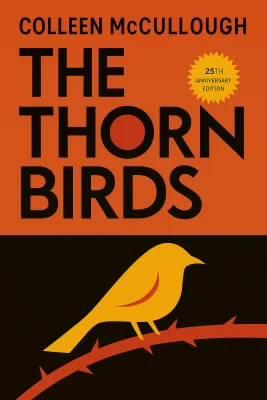
The Thorn Birds
Categories
Fiction, Classics, Historical Fiction, Romance, Historical Romance, Book Club, Historical, Novels, Australia, Drama
Content Type
Book
Binding
Mass Market Paperback
Year
1976
Publisher
Avon Books
Language
English
ASIN
B0DLSX3M6M
File Download
PDF | EPUB
The Thorn Birds Plot Summary
Introduction
# The Thorn Bird's Song: Love, Faith, and Sacrifice Across Generations In the red dust of the Australian outback, where the sun burns merciless and the land stretches endless, a telegram arrives that will reshape the destiny of the Cleary family. Mary Carson, wealthy and bitter, summons her poor Irish relatives to Drogheda station with promises of work and inheritance. But her true gift will be far more dangerous: the introduction of young Meggie Cleary to Father Ralph de Bricassart, a priest of uncommon beauty and towering ambition. Their first meeting ignites a love that will span decades and challenge the very foundations of faith itself. Like the legendary thorn bird that impales itself upon the sharpest spike to sing one perfect, heartbreaking song, their passion will create something beautiful and terrible. For in the harsh landscape of desire and duty, some loves can only be expressed through sacrifice, and some songs can only be sung at the cost of everything held dear.
Chapter 1: Seeds in Red Dust: The Clearys Arrive at Drogheda
The train wheezed to a halt at Gillanbone station, disgorging the Cleary family into the scorching heat of 1921 Australia. Paddy Cleary gripped his wife Fee's arm as their children gathered their meager possessions. Frank, dark and brooding at twenty-two, already saw escape in the distant horizon. The younger boys—Bob, Jack, Hughie, and Stuart—stared wide-eyed at the alien landscape. But it was ten-year-old Meggie who would matter most, clutching her precious doll Agnes with hair like spun copper catching the brutal sun. Mary Carson emerged from the homestead like an empress surveying new subjects. Wealthy beyond measure and sharp as broken glass, she ruled Drogheda station with an iron will wrapped in silk gloves. Her pale eyes missed nothing as she evaluated her poor relations, lingering longest on little Meggie with calculating interest. The child possessed something rare—a beauty that would one day command attention and reshape destinies. The family settled into their new life with desperate gratitude. Paddy took charge of the vast sheep runs, learning to read the moods of land that could kill the unprepared. Fee retreated into her books and silence, carrying secrets that would surface only under extreme pressure. The boys adapted to station life with varying degrees of success, but it was Meggie who truly bloomed in the red dust and endless sky. When Father Ralph de Bricassart arrived for his monthly visit, everything changed. Tall and aristocratic with dark hair and piercing blue eyes, he possessed an otherworldly beauty that seemed almost blasphemous in a priest. At thirty, he carried himself with the confidence of one destined for greatness within Church hierarchy. When he knelt to speak with Meggie, something passed between them that neither fully understood—a recognition that would echo through decades of joy and torment. Mary Carson watched this first meeting with growing fascination. She had loved Ralph from afar, nursing a passion that would never be returned. In her jealousy and cunning, she began weaving a web that would entrap them all, setting in motion events that would destroy and create in equal measure.
Chapter 2: Forbidden Bonds: The Priest and the Golden Child
Years flowed like seasons across Drogheda, and Meggie transformed from child to young woman under Ralph's unknowing tutelage. At seventeen, she possessed beauty that stopped conversations—copper hair cascading like liquid fire, grey eyes luminous with unspoken dreams. But her heart belonged entirely to Father Ralph, though she barely understood the dangerous nature of her devotion. Ralph watched her transformation with growing torment. What had begun as innocent affection for a lonely child had deepened into something far more perilous. He found excuses to visit Drogheda more frequently, drawn by forces he dared not name. When her brothers worked the distant paddocks and the homestead fell quiet, he would walk with Meggie through Mary Carson's rose garden, their conversations dancing around truths neither could speak aloud. The crisis erupted during a summer storm that trapped them alone in the homestead. Lightning split the sky and rain hammered the iron roof as Ralph found himself drawn to where Meggie sat reading. The book tumbled from her hands as he approached, and suddenly they were in each other's arms, his mouth finding hers with desperate hunger. For one perfect moment, the priest forgot his vows and the girl forgot everything but the man she loved. Reality crashed back like thunder. Ralph tore himself away, his face a mask of anguish and self-recrimination. He spoke of duty, of his calling to God, of the impossibility of their love. Meggie listened with tears streaming down her face, understanding for the first time that the man she adored would never truly be hers. The kiss had awakened something in both of them that could never be put back to sleep. Mary Carson observed these developments with malicious satisfaction. Her final gambit was already in motion—a will that would bind Ralph to Drogheda forever while ensuring he could never have what he truly wanted. The spider's web was nearly complete, and soon all the flies would be caught.
Chapter 3: Ambition's Victory: Love Sacrificed for Sacred Glory
Mary Carson's death came on a sweltering night, her body discovered bloated and grotesque in the morning heat. But her true legacy lay in the documents on her desk—a will that would reshape every life at Drogheda. The vast fortune that should have gone to Paddy flowed instead to the Catholic Church, with Father Ralph as administrator. Thirteen million pounds, enough to buy a cardinal's hat and everything that came with it. The reading of the will fell like hammer blows on the assembled family. Paddy's face cycled through white shock, red rage, then settled into a mask of betrayal. Fee said nothing, but her silence carried more condemnation than any accusation. The boys shifted uncomfortably, sensing adult currents of anger and disappointment they couldn't fully grasp. Only Meggie seemed untouched by the revelation, her grey eyes fixed on Ralph with the same trusting love she had always shown. Ralph faced the choice Mary Carson had engineered with surgical precision. Burn the will and preserve the love of the only family that had ever truly accepted him, or present it for probate and claim his place among the princes of the Church. The decision, when it came, felt inevitable. He had been shaped by ambition from his earliest days, molded by a system that rewarded cunning and punished sentiment. The final conversation came at dawn beside the cemetery where little Hal lay buried. Ralph tried to explain, to make Meggie understand that what she felt was merely schoolgirl infatuation that would fade with time. But even as he spoke the words, he knew they were lies. What existed between them was deeper than attraction, more dangerous than simple affection. As his car disappeared down the track toward Gillanbone, Ralph left behind a family forever changed by his betrayal. Mary Carson had read him perfectly—he was exactly the man she believed him to be: beautiful, brilliant, and ultimately hollow. The spider had won her final victory from beyond the grave, and the price would haunt him through all the glittering years to come.
Chapter 4: Stolen Paradise: Three Days That Changed Everything
Luke O'Neill arrived at Drogheda like a dark mirror of Ralph—tall, black-haired, with the same vivid blue eyes and powerful build. But where Ralph moved with otherworldly grace, Luke carried himself like a predator, and where Ralph's beauty held spiritual quality, Luke's was earthbound and immediate. He was a cane cutter, a drifter who had worked his way across Queensland with nothing but strength and ambition. Meggie married him in desperate flight from memories of Ralph, convincing herself that Luke's resemblance might heal the wound in her heart. But marriage became exile in the suffocating humidity of North Queensland, where Luke abandoned her to pursue his obsession with the sugar harvest. She worked as a housemaid for the kind Muellers while Luke lived in cutting barracks, visiting only when he needed money or desired her body. The years ground past like millstones, crushing hope beneath their weight. Meggie bore Luke a daughter—Justine, sharp-tongued and fierce from birth, as if she had absorbed her parents' mutual rejection in the womb. But motherhood without joy was simply another form of servitude, and Meggie found herself trapped in a life that slowly drained away everything beautiful about her. Then Ralph returned, now Archbishop de Bricassart, his dark hair touched with silver and his face bearing the marks of power achieved. He had come to check on Church business, he claimed, but they both knew the truth. On Matlock Island, in the tropical heat that made everything seem like fever dreams, they finally surrendered to the passion that had tormented them for decades. For three days they lived as man and wife in everything but name, their love finally given physical form. Ralph forgot his vows, his ambitions, his carefully constructed life. Meggie forgot Luke, forgot duty, forgot everything but the man she had loved since childhood. It was their moment of perfect happiness, stolen from a world that would never understand or forgive. When Ralph finally tore himself away, he left behind more than just a broken heart—he left behind a child conceived in those stolen hours of paradise.
Chapter 5: Echoes of the Father: Dane's Divine Calling
Dane O'Neill was born beautiful beyond description, with his father's aristocratic features and an otherworldly quality that marked him as special from his first breath. Meggie never told Ralph the truth, never sent word of what their three days had created. Instead, she let the world believe the golden child belonged to Luke, who showed no interest in either of his supposed offspring. The boy grew up on Drogheda surrounded by love but shadowed by secrets he could never know. Even as a child, Dane possessed a spiritual quality that set him apart—spending hours in prayer, drawn to contemplation with an intensity that both amazed and frightened his family. His beauty was almost supernatural, his intelligence remarkable, and his devotion to God absolute. Ralph, now Cardinal de Bricassart moving through the highest circles of Vatican power, made rare visits to Australia on Church business. When he looked upon Dane, something stirred in his heart—a recognition he refused to acknowledge, a resemblance he would not allow himself to see. The boy seemed familiar in ways that defied explanation, but Ralph buried such thoughts beneath layers of duty and denial. At eighteen, Dane announced his intention to become a priest with the same serene certainty that marked everything about him. The calling was not a choice but an inevitability, as natural as breathing. He spoke of offering everything to God—his beauty, his intelligence, his potential for earthly love—as the only gift worthy of divine grace. Meggie felt her world collapse as history prepared to repeat itself with cruel precision. She had given one man to the Church and lost him forever; now she was being asked to surrender her son to the same fate. The irony was almost unbearable—that Dane, born of her forbidden love with Ralph, should choose the very path that had torn them apart. But saints belonged to God before they belonged to anyone else, and her son was clearly destined for sainthood.
Chapter 6: Truth Unveiled: A Cardinal's Devastating Discovery
The ordination of Father Dane O'Neill was held in St. Peter's Basilica, a ceremony of breathtaking beauty attended by cardinals and dignitaries from across the Catholic world. None watched with more intensity than Ralph de Bricassart, who performed the sacred ritual that would forever bind the young man to God's service. As Dane lay prostrate before the altar, his arms spread in the shape of a cross, Ralph felt profound mixture of joy and sorrow. Here was everything he had hoped to be as a young priest—pure, devoted, untainted by the compromises and ambitions that had marked his own rise to power. The resemblance between them was so striking that others commented on it, satisfied by the fiction that they were uncle and nephew. But something deeper stirred in Ralph's heart, a connection that transcended mere family ties. The celebration afterward was magnificent, attended by Cleary men who had traveled from Australia to witness this moment of family pride. Only Meggie was absent, claiming illness but really unable to bear watching her son give himself to the Church that had already claimed so much from her. Dane, radiant in his new priesthood, thanked Cardinal de Bricassart for his guidance, calling him the perfect example of what a priest should be. But it was Justine who inadvertently lit the fuse that would destroy Ralph's carefully constructed world. In casual conversation, she mentioned that the Cardinal was no relation to their family—merely an old friend who had known their mother years ago. The words hit Ralph like physical blows as implications became clear. If he was not Meggie's brother, then Dane could not be his nephew. The resemblance everyone had noted, the spiritual connection he felt with the young priest, the timing of Dane's birth—all of it suddenly made terrible, perfect sense. Dane O'Neill was his son, born of those three stolen days on Matlock Island, and he had just ordained his own child to a life of celibacy and service to God. The revelation shattered his world with the force of divine judgment.
Chapter 7: The Final Song: Death, Loss, and Liberation
The knowledge consumed Ralph like cancer. For twenty-six years, he had unknowingly watched his son grow from a distance, had guided his spiritual development, had even performed the ceremony that bound Dane to the same vows that had torn Ralph himself apart. The irony was so complete, so devastating, that it seemed like punishment for his years of pride and ambition. When Meggie finally confirmed what he had already realized, Ralph felt the full weight of his choices crash down upon him. He had given up earthly love for heavenly glory, had sacrificed her happiness for his own advancement, and now discovered that his greatest achievement as a priest had been to ordain his own son to the same life of sacrifice. His health, already fragile from years of stress and responsibility, began to fail rapidly under the burden of this knowledge. But before he could find peace, tragedy struck with the cruel swiftness of fate. Dane, on holiday in Greece, drowned while attempting to rescue swimmers in distress. The young priest who had seemed destined for greatness died as he had lived—in service to others, his beauty and goodness extinguished in an instant. The news reached Ralph like a death blow to his already weakened heart. Ralph de Bricassart died within hours of learning of his son's death, never having had the chance to claim Dane as his own or to seek forgiveness for the choices that had shaped all their lives. He achieved everything he had dreamed of—power, prestige, position within the Church hierarchy—but the price was the love of his life and the son he never knew he had. Justine, devastated by her brother's death and consumed with guilt for not being there to save him, retreated into her work and her pain. She pushed away all offers of comfort, including those from Rainer Hartheim, the German politician who had loved her for years. It took time, patience, and her mother's wisdom to finally make her understand that some tragedies cannot be prevented, some losses cannot be undone, and some loves are worth the risk of pain.
Summary
In the end, the thorn bird's song echoes across the red dust of Drogheda, a melody of love and loss that spans generations. Ralph de Bricassart's ambition, like the thorn that pierces the bird's breast, created the most beautiful music even as it brought destruction. He gained the world but lost his soul, achieving everything he dreamed of while sacrificing everything that truly mattered. Meggie Cleary loved completely and paid completely, her strength lying not in avoiding pain but in enduring it, in finding ways to love despite the cost. The legacy of their choices ripples outward like stones cast into still water, touching lives across decades and continents. Justine, marked by loss but not destroyed by it, finally learns to open her heart to love without demanding guarantees. In the vast Australian landscape where it all began, the wind still carries the echo of that perfect, heartbreaking song, reminding us that sometimes the most beautiful things in life come only through the greatest sacrifice, and that love, in all its forms, remains the force that gives meaning to our brief time beneath the endless sky.
Best Quote
“There is a legend about a bird which sings just once in its life, more sweetly than any other creature on the face of the earth. From the moment it leaves the nest it searches for a thorn tree, and does not rest until it has found one. Then, singing among the savage branches, it impales itself upon the longest, sharpest spine. And, dying, it rises above its own agony to outcarol the lark and the nightingale. One superlative song, existence the price. But the whole world stills to listen, and God in His heaven smiles. For the best is only bought at the cost of great pain… Or so says the legend.” ― Colleen McCullough, The Thorn Birds
Review Summary
Strengths: The review highlights the book's emotional impact and its ability to resonate deeply with readers, describing it as "Fantastically HUMAN" and "FLESH & BLOOD writing." It is praised for its realistic portrayal of life and its influence on the reader's personal faith journey. Weaknesses: The review also points out a significant moral issue, identifying the novel's hero as a pedophile who grooms a young girl, which is described as a "horrible" aspect of the book. Overall: The reader expresses a complex sentiment, acknowledging both the profound personal impact and the troubling ethical concerns within the narrative. The recommendation is mixed, with appreciation for its depth but caution due to its controversial content.
About Author

Colleen McCullough
McCullough explores the intricacies of human relationships and historical narratives with a keen eye for detail and emotion. Known for her profound storytelling, she crafted novels that not only entertain but also delve into themes of love, loss, and familial dynamics. Her early work, "Tim," delves into the delicate romance between a mentally disabled young man and an older woman, challenging societal norms. Meanwhile, "The Thorn Birds," perhaps her most famous book, traces the saga of an Australian family, intertwining personal struggles with broader societal changes, captivating millions worldwide with its emotional depth.\n\nDrawing from her extensive background in both science and humanities, McCullough’s writing is distinguished by meticulous planning and a disciplined approach. This dual expertise is evident in her ambitious "Masters of Rome" series, where historical accuracy and rich character development bring ancient Roman figures to life. This blend of scientific precision and narrative flair results in a vivid exploration of power dynamics and political intrigue, offering readers a comprehensive view of history through a literary lens.\n\nHer legacy extends beyond her narratives, impacting readers who seek not only entertainment but a deeper understanding of the human condition. Through her thoughtful exploration of themes and her ability to intertwine personal and historical narratives, McCullough's work remains relevant and engaging. This bio underscores her contributions to literature, marked by her recognition as an Officer of the Order of Australia, celebrating a career that bridged scientific inquiry with literary craftsmanship.
Read moreDownload PDF & EPUB
To save this Black List summary for later, download the free PDF and EPUB. You can print it out, or read offline at your convenience.
The Thorn Birds
by Colleen McCullough
