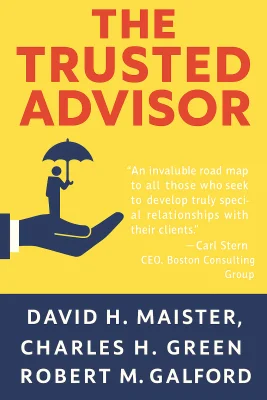
The Trusted Advisor
Categories
Business, Nonfiction, Self Help, Finance, Communication, Leadership, Audiobook, Management, Personal Development, Buisness
Content Type
Book
Binding
Paperback
Year
2001
Publisher
Free Press
Language
English
File Download
PDF | EPUB
The Trusted Advisor Plot Summary
Introduction
Picture this: You're sitting across from a potential client, armed with impressive credentials, years of experience, and a solution that could transform their business. Yet something feels off. They're polite but distant, asking about your qualifications repeatedly, questioning every recommendation. Despite your expertise, you sense a wall between you that technical knowledge alone cannot breach. This scenario plays out in boardrooms, consulting offices, and client meetings worldwide every single day. What separates the professionals who struggle with such encounters from those who effortlessly build deep, lasting partnerships with their clients? The answer isn't found in advanced degrees or industry certifications, though these matter. It lies in something far more fundamental yet surprisingly elusive: the ability to earn and maintain trust. This book reveals the specific, learnable skills that transform ordinary professional relationships into extraordinary trusted partnerships. Through real stories from the trenches and practical frameworks tested across industries, you'll discover how to move beyond being seen as just another service provider to becoming the advisor your clients turn to first, trust most, and recommend enthusiastically to others.
Chapter 1: The Trust Equation: Four Elements That Build Client Confidence
David Maister recalls a pivotal moment early in his consulting career when he learned that being right isn't enough. Called in to assess a professional firm's operations, he delivered a brutally honest diagnosis, pointing out exactly what they were doing wrong and prescribing specific solutions. His analysis was spot-on, his recommendations sound. Yet to his shock, the firm fired him for being disruptive. This painful experience taught him that technical correctness without trust is not just ineffective—it's counterproductive. Years later, Maister would codify this insight into what became known as the Trust Equation. Trust, he discovered, isn't a vague feeling but a measurable outcome of four specific components: Credibility plus Reliability plus Intimacy, all divided by Self-Orientation. Credibility represents your track record and expertise—the rational foundation that makes people believe you know what you're talking about. Reliability captures consistency over time, the accumulated evidence that you do what you say you'll do. Intimacy reflects the safety clients feel in sharing sensitive information with you, knowing you'll handle it with care and discretion. But the denominator, Self-Orientation, often proves most crucial—it's the degree to which your focus remains on yourself rather than genuinely serving your client's interests. This equation reveals why brilliant consultants sometimes fail while less technically gifted advisors build thriving practices: trust is mathematical, and self-focus divides everything else.
Chapter 2: Masters of Connection: Stories from Exceptional Advisors
When basketball superstar Michael Jordan needed representation, he chose David Falk not just for his negotiating skills, but for something far more valuable. Falk possessed an almost supernatural ability to anticipate Jordan's needs and concerns before they were even voiced. In two separate instances, Falk voluntarily reduced his fees without being asked, sensing that Jordan wanted him to but would never make such a request directly. This intuitive understanding of his client's unstated preferences became the foundation of a partnership that generated hundreds of millions of dollars and lasted decades. Similarly, Regina Pisa, managing partner of a prestigious Boston law firm, experienced the ultimate test of a trusted advisor relationship when a CEO client received devastating news about his terminal illness. Walking into her office with his wife, he said something that would define the relationship forever: "I want you to do for my wife what you did for me. We're putting ourselves in your hands to help us through all of this." The legal work—estate planning, documentation—became secondary to something much more profound. Pisa had become not just a legal advisor but a trusted guide through life's most challenging passage. These stories illuminate a crucial truth: exceptional advisors transcend their technical roles by developing an almost radar-like sensitivity to their clients' deeper needs, fears, and unspoken concerns.
Chapter 3: The Five-Stage Journey to Trusted Advisor Status
Charlie Green once watched Tim White, publisher of a major newspaper, masterfully conduct a management team meeting without ever expressing a single opinion or making a technical point. Instead, White spent the entire session reading faces, noting body language, and drawing out dissenting views. "Joe, you don't agree with that, do you?" he would ask, or "Bob, you've got some pretty strong feelings about this one, don't you?" By the meeting's end, not only had important decisions been made, but everyone felt heard and valued in the process. White's approach exemplified the five-stage journey that transforms ordinary professionals into trusted advisors. The process begins with Engagement—capturing genuine attention around issues that matter. This leads to Listening, where the advisor earns the right to understand not just facts but feelings and context. Next comes Framing, where complex problems get crystallized into clear, actionable insights. The fourth stage, Envisioning, involves jointly imagining what success looks like before rushing to solutions. Finally, Commitment ensures everyone understands what it will truly take to achieve the envisioned outcome. Most professionals, driven by urgency and ego, leap directly from problem identification to solution recommendation, skipping the crucial middle stages where trust actually develops. The paradox is clear: slowing down to build trust actually accelerates long-term success and deepens client relationships far beyond what technical expertise alone can achieve.
Chapter 4: Breaking Through Barriers: Why Trust is Hard to Build
The medical records showed everything was perfect. Rob Galford's three-year-old daughter had just undergone six hours of complex surgery by one of the world's most renowned pediatric surgeons, a man so skilled that books had been written about his hands. Yet when this surgical genius emerged from the operating room, he looked at the anxious parents and casually said, "Don't worry. He's fine." When Rob and his wife almost shouted in unison, "She's a she!" the surgeon shrugged indifferently and replied, "Oh yeah, I meant to say 'she.' Anyway, she'll be fine. Complex surgery. Interesting case. We videotaped it." Then he simply walked away, leaving two grateful but dumbfounded parents in his wake. This story perfectly captures why trust remains so elusive in professional relationships. The surgeon possessed unquestionable credibility and reliability—perhaps the highest in the world. But his complete lack of intimacy and obvious self-orientation nearly shattered the trust equation. He could get away with such behavior only because his technical excellence was literally world-famous, but the rest of us cannot. The barriers to trust often stem from our professional training itself: we're taught that content expertise is everything, that appearing vulnerable shows weakness, and that maintaining emotional distance demonstrates professionalism. These very beliefs create the walls that keep clients at arm's length, making us appear more like vendors than valued advisors, regardless of our technical competence.
Chapter 5: The Emotional Intelligence of Client Engagement
Ellen, a partner in an accounting firm, found herself delivering unwelcome news to a client controller when she noticed his face reddening and his knuckles turning white. Every instinct screamed danger—there goes the account, how can I escape this situation? But instead of retreating into technical explanations or rushing through her presentation, Ellen did something remarkable. She paused, took a deep breath, and simply said, "You look a little angry." Then she waited silently for his response. The client's initial reaction was explosive: "No, I'm not angry! Not at all!" But then something shifted. "Well, I mean, not at you," he continued. "I'm angry at our people. You shouldn't have to be the one bringing this news to me—it's embarrassing. I'm glad you pointed it out. Yes, I'm angry, but not at you." This moment of emotional courage transformed what could have been a relationship-ending confrontation into a deeper partnership. Ellen learned that acknowledging emotions doesn't create them—it simply gives them a safe place to exist and be addressed. The emotional intelligence required for trusted advisor status goes far beyond reading facial expressions or managing difficult conversations. It demands the courage to name what everyone feels but no one says, to stay present with discomfort rather than rushing to solutions, and to remember that behind every business decision stands a human being with fears, hopes, and pressures we may never fully understand. This emotional dimension often proves more crucial than technical mastery in determining whether clients see us as indispensable partners or replaceable vendors.
Chapter 6: Practical Tools: From First Impression to Lasting Relationship
When David Maister needed legal help to probate a relative's will, the first few lawyers he contacted tried winning his business by reciting their firm's founding date, office locations, and fee structure. None of this inspired confidence—in fact, the more they talked about themselves, the less interested they seemed in his actual problem. Then he encountered a different kind of lawyer who asked a simple question: "How much do you know about probating a will?" When David answered "Nothing," the lawyer immediately faxed him a comprehensive outline of the entire process, including phone numbers for governmental bodies he needed to notify, even though none of this involved legal work or generated fees. This lawyer understood a fundamental principle of trust-building: you must give value before you can expect to receive it. He demonstrated his knowledge not through credentials but through generous sharing of useful information. He proved his client focus not through claims but through actions that made David's life easier. The practical tools for building trust operate on this same principle of generous demonstration rather than self-serving assertion. The most effective trust-building happens through accumulating small, consistent gestures that show genuine care for the client's success. Returning calls within ten minutes when possible, remembering personal details from previous conversations, sending relevant articles without being asked, preparing meeting summaries that clients can use internally without modification—these seemingly minor actions create the foundation upon which major business relationships are built. The secret lies not in grand gestures but in the steady accumulation of evidence that you consistently put the client's interests ahead of your own convenience, comfort, or immediate profit.
Chapter 7: The Columbo Approach: Humility as a Strategic Advantage
Lieutenant Columbo, the rumpled detective played by Peter Falk, appears to embody everything a professional should avoid. He drives a beat-up car, wears a wrinkled trench coat, and constantly seems confused and overwhelmed. He asks to use the restroom, fumbles for words, and appears utterly non-threatening to the sophisticated criminals he investigates. Yet this carefully cultivated persona of incompetence masks a brilliant strategic mind that consistently outmaneuvers opponents who vastly underestimate him. Columbo's genius lies in his ability to make others feel comfortable enough to reveal themselves fully. While most professionals work to intimidate clients with displays of expertise, credentials, and authority, Columbo does the opposite. He punctures pretension with genuine curiosity, replaces judgment with questions, and substitutes ego with empathy. His famous phrase, "Just one more thing," delivered with apologetic humility, often elicits the most crucial information precisely because it doesn't feel threatening. The Columbo approach reveals a profound paradox about professional effectiveness: the more we try to impress clients with our superiority, the more we actually diminish trust and openness. True professional power comes not from demonstrating how much smarter we are than our clients, but from creating an environment where they feel safe to share their real concerns, admit their uncertainties, and explore possibilities without fear of judgment. Humility, far from being a weakness, becomes the ultimate strategic advantage in building the kind of relationships where breakthrough solutions emerge naturally from collaborative exploration rather than expert pronouncement.
Summary
The journey from service provider to trusted advisor isn't just about developing new skills—it's about fundamentally reimagining what it means to serve others professionally. The stories throughout this exploration reveal that the most successful client relationships transcend technical expertise to embrace something far more human: the courage to be genuinely curious about others, the discipline to focus on their success rather than our own validation, and the wisdom to know that trust, once earned, becomes the foundation for extraordinary professional achievement. Whether you're just beginning your career or seeking to deepen existing client relationships, the path forward is both simple and profound. Listen more than you speak. Ask questions that demonstrate genuine care for understanding rather than showcasing your knowledge. Share your expertise generously, knowing that teaching clients often proves more valuable than dazzling them. Most importantly, remember that every interaction is an opportunity to deposit trust or withdraw it—and the choice is entirely yours. In a world increasingly dominated by technology and automation, the ability to form authentic human connections becomes not just valuable but irreplaceable, promising both professional success and the deeper satisfaction that comes from truly serving others.
Best Quote
“There is an old saying, “It is amazing what you can achieve if you are not wedded to who gets the credit.” The” ― David H. Maister, The Trusted Advisor: 20th Anniversary Edition
Review Summary
Strengths: The book is praised for its logical organization and effective use of lists. It provides numerous real-world examples from experienced consultants, enhancing its practical applicability. The review highlights valuable insights on building trust, such as advising with empathy, understanding client interests, and focusing on dialogue rather than just solutions. Overall: The review conveys a positive sentiment, recommending the book as essential reading for consultants and advisors. It emphasizes the importance of trust in client relationships and offers practical advice on how to cultivate it. The book is suggested as a valuable resource for those seeking to improve their consulting skills and client interactions.
About Author

Charles H. Green
Green extends his expertise to interrogate the intricacies of trust within professional relationships, blending philosophical insights with practical business strategies. His work emphasizes the importance of honesty, authenticity, and client focus in building long-term value. Through his business strategy consultancy, Trusted Advisor Associates, founded in 1995, Green crafts frameworks that encourage professionals to nurture trust-based relationships, thus enhancing their client-development and advisory skills.\n\nA hallmark of Green's writing is its philosophical depth combined with actionable advice, a style evident in books like "The Trusted Advisor" and "Trust-Based Selling: Using Customer Focus and Collaboration to Build Long-Term Relationships." While his early books focused on strategic financial advice, his later works delve deeper into the dynamics of trust in business. By teaching executive education courses at renowned institutions such as Columbia Business School and Northwestern University's Kellogg School of Management, Green demonstrates the practical application of his theories in complex business environments.\n\nReaders and professionals in the consulting sector benefit significantly from Green's insights, as his bio reveals an author deeply committed to fostering trust and cooperation in business. His contributions, featured in notable management journals, are designed to help practitioners cultivate more meaningful and effective client interactions, ultimately leading to sustained business success.
Read moreDownload PDF & EPUB
To save this Black List summary for later, download the free PDF and EPUB. You can print it out, or read offline at your convenience.
The Trusted Advisor
by Charles H. Green
