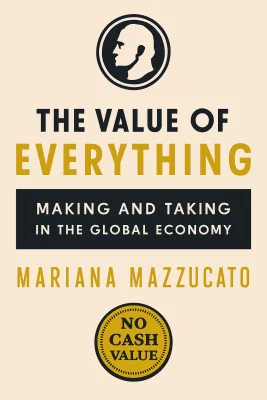
The Value of Everything
Making and Taking in the Global Economy
Categories
Business, Nonfiction, Philosophy, Finance, History, Economics, Politics, Audiobook, Sustainability, Society
Content Type
Book
Binding
Hardcover
Year
2018
Publisher
PublicAffairs
Language
English
ASIN
161039674X
ISBN
161039674X
ISBN13
9781610396745
File Download
PDF | EPUB
The Value of Everything Plot Summary
Introduction
The distinction between value creation and value extraction lies at the heart of understanding modern economic inequality. For centuries, economic thinkers have grappled with defining what constitutes true economic value and who genuinely creates it. Today, this question has become increasingly urgent as we witness unprecedented wealth concentration alongside stagnating wages for most workers. The financial sector claims to be creating value while consuming an ever-larger share of economic resources, tech entrepreneurs present themselves as heroic wealth creators while relying heavily on publicly funded innovations, and pharmaceutical companies justify astronomical drug prices through claims of value-based pricing. This fundamental confusion between value creation and extraction has profound consequences. When we fail to distinguish between activities that generate new wealth and those that merely redistribute existing wealth, we enable and justify growing inequality. The narrative that certain economic actors are "wealth creators" who deserve their outsized rewards has become so entrenched that it shapes policy decisions, tax structures, and even how we measure economic success through metrics like GDP. By critically examining these narratives and the theories of value that underpin them, we can begin to recognize how the economy might be restructured to reward genuine value creation rather than extraction, potentially leading to more sustainable and equitable prosperity.
Chapter 1: The Evolution of Value Theory: From Production to Price
The concept of value has undergone dramatic transformations throughout economic history. Classical economists like Adam Smith and David Ricardo developed theories of value based on the costs of production, particularly labor. For them, value was objective and determined by the amount of work required to produce goods. This perspective led them to distinguish between productive activities that created new wealth and unproductive activities that merely transferred existing wealth. They viewed rent-seeking—extracting income without creating new value—as fundamentally unproductive. Karl Marx further developed this labor theory of value, arguing that surplus value was created by workers but appropriated by capitalists. He refined the distinction between productive and unproductive labor, focusing on whether activities produced surplus value within the capitalist production system. This classical approach to value theory established a clear "production boundary" separating wealth-creating activities from wealth-extracting ones, with financial activities generally falling outside this boundary. In the late 19th century, a dramatic shift occurred with the rise of neoclassical economics. Economists like William Stanley Jevons, Carl Menger, and Léon Walras developed a subjective theory of value based on utility and scarcity. Value was no longer determined by objective conditions of production but by individuals' subjective preferences. According to this marginalist revolution, the price of something in the market became the measure of its value. This effectively erased the distinction between productive and unproductive activities—if something commanded a price, it was by definition creating value. This transformation in value theory coincided with significant social and political changes, including the rise of socialism and consolidation of capitalist power. The marginalist approach conveniently justified the existing distribution of income and wealth as reflecting each person's contribution to the economy. The concept of unearned income essentially disappeared, as all income was now seen as a reward for productivity. This theoretical shift fundamentally altered how we understand economic value and who creates it, with profound implications for how we measure economic success and design economic policies. The neoclassical approach to value remains dominant today, embedded in economic textbooks, policy frameworks, and national accounting systems. By treating price as the measure of value, it provides a seemingly objective way to assess economic contribution while obscuring questions about power, distribution, and the social conditions of production. This has created an intellectual environment where value extraction can easily masquerade as value creation.
Chapter 2: Financial Capitalism: Engineering Profits Without Productivity
The financial sector has undergone a remarkable transformation in recent decades, evolving from a facilitator of economic activity into a dominant force that extracts value from the real economy. Until the 1970s, finance was largely viewed as unproductive—transferring existing wealth rather than creating new wealth. National accounts reflected this understanding by treating most financial activities as intermediate inputs rather than final outputs contributing to GDP. However, through a combination of deregulation, political influence, and changing economic theories, finance was gradually redefined as productive. This redefinition occurred through several mechanisms. First, financial services were incorporated into GDP calculations through a measure called "Financial Intermediation Services Indirectly Measured" (FISIM), which essentially treats the interest rate spread between what banks charge borrowers and pay depositors as value added. Second, deregulation allowed banks to engage in increasingly speculative activities while maintaining their privileged position in the economy. The repeal of the Glass-Steagall Act, which had separated commercial and investment banking, exemplified this trend. As finance grew, it developed new ways to extract value from the economy. Banks created complex financial instruments like mortgage-backed securities and credit default swaps that generated enormous profits while increasing systemic risk. The sector's share of corporate profits in the US rose from around 15% in the post-war period to 40% by the early 2000s. Meanwhile, financial sector compensation skyrocketed, with the ratio of finance wages to average wages nearly doubling between 1980 and 2009. The 2008 financial crisis revealed the destructive potential of this value extraction machine. Banks had profited enormously from creating and trading risky financial products, but when these products collapsed in value, the costs were borne by society through bailouts, job losses, and economic contraction. Yet remarkably, the financial sector quickly rebounded after the crisis, with profits and compensation returning to pre-crisis levels while the rest of the economy struggled to recover. This pattern illustrates how finance has become a mechanism for extracting rather than creating value. Instead of channeling savings into productive investment, the financial sector increasingly directs resources toward speculative activities that generate profits for financial institutions without enhancing the productive capacity of the economy. The growth of household debt further exemplifies this dynamic, as stagnating wages forced many to borrow simply to maintain their standard of living, creating new opportunities for financial value extraction.
Chapter 3: Corporate Value Extraction: Shareholder Primacy's Hidden Costs
The doctrine of maximizing shareholder value (MSV) has fundamentally transformed corporate behavior since the 1970s, creating powerful mechanisms for value extraction. This ideology, popularized by economists like Milton Friedman and Michael Jensen, holds that the sole purpose of corporations is to maximize returns to shareholders. It emerged during a period of economic stagnation and was presented as a solution to perceived managerial inefficiency, arguing that aligning executive incentives with shareholder interests would improve corporate performance and benefit the entire economy. In practice, MSV has led to a dramatic shift from long-term investment to short-term value extraction. One of the most visible manifestations is the explosion of share buybacks, where companies purchase their own stock to boost share prices. Between 2003 and 2012, S&P 500 companies spent 54% of their earnings on buybacks and another 37% on dividends, leaving just 9% for productive investment. These buybacks artificially inflate earnings per share metrics that determine executive compensation, creating a self-reinforcing cycle that benefits executives and shareholders at the expense of long-term value creation. Corporate time horizons have shortened dramatically under the influence of MSV. The average holding period for stocks has collapsed from years to months or even seconds in some cases. This short-termism is reflected in corporate decision-making, with companies increasingly focused on quarterly earnings targets rather than long-term growth strategies. Investment in physical capital and R&D has declined, with business investment as a percentage of GDP reaching historic lows despite record corporate profits. The financialization of non-financial corporations represents another dimension of corporate value extraction. Companies like Ford and General Electric developed financial arms that eventually generated more profit than their core businesses. Even essential public services have been transformed through financial engineering, as private equity firms have acquired care homes and water utilities, loading them with debt while extracting dividends and management fees. These practices typically involve complex ownership structures that minimize tax payments while maximizing value extraction. The consequences of these corporate value extraction mechanisms extend beyond individual companies to the broader economy. The shift from "retain and invest" to "downsize and distribute" has contributed to declining productivity growth, wage stagnation, and increasing inequality. Workers' share of corporate income has steadily declined, while executive compensation has skyrocketed. CEO pay in the US rose from roughly 20 times average worker pay in 1965 to over 300 times by the early 2000s, reflecting how value extraction has been concentrated among a small elite.
Chapter 4: Innovation Myths: How Public Investment Creates Private Wealth
The innovation economy is surrounded by powerful myths that obscure systematic patterns of value extraction. Silicon Valley entrepreneurs and pharmaceutical executives are celebrated as heroic wealth creators whose enormous rewards reflect their exceptional contributions to society. However, examining the actual processes of innovation reveals a different reality: one where risks are socialized while rewards are privatized. Innovation is inherently collective, cumulative, and uncertain. Most innovations build on decades of prior knowledge development, much of it funded by taxpayers. The technologies underlying the iPhone, for instance, were largely developed through public funding: the internet, GPS, touchscreens, and even Siri all trace their origins to government research programs. Similarly, two-thirds of the most innovative drugs trace their research back to funding by the National Institutes of Health. Innovation is also highly uncertain, with most attempts ending in failure and requiring patient, long-term investment that private capital is often unwilling to provide. Despite this collective nature of innovation, the rewards are increasingly captured by a small number of private actors. Venture capitalists exemplify this dynamic. While portrayed as bold risk-takers, they typically enter the innovation process after the riskiest early-stage research has been funded by public agencies. Their genius lies in timing—entering late enough to minimize risk but early enough to capture enormous returns when companies go public. When Peter Thiel invested $500,000 in Facebook in 2004, he was building on decades of publicly funded research that created the internet and web technologies. The patent system has evolved from a mechanism to stimulate innovation into a tool for value extraction. Changes since the 1980s have expanded what can be patented, extended patent protection periods, made patents easier to obtain, and enabled strategic patenting to block competitors. The Bayh-Dole Act allowed universities to patent publicly funded research, effectively privatizing knowledge that previously would have been freely available. "Patent trolling"—acquiring patents solely to extract licensing fees—has become a lucrative business model that imposes billions in costs on productive companies. Pharmaceutical pricing provides a stark example of value extraction in the innovation economy. Companies justify astronomical drug prices through "value-based pricing"—charging based on the economic value of lives saved or improved rather than the actual cost of development. This approach ignores the substantial public investment in basic research and clinical trials that makes these drugs possible. When taxpayers fund the riskiest research but receive no direct return on this investment, while pharmaceutical companies capture enormous profits, the result is a system that socializes risks while privatizing rewards.
Chapter 5: The Entrepreneurial State: Reclaiming Government's Value-Creating Role
The public sector plays a crucial yet systematically undervalued role in creating economic value. Conventional economic wisdom portrays government as inherently unproductive—a necessary burden that at best facilitates private sector value creation and at worst impedes it through inefficient bureaucracy and wasteful spending. This narrative is reflected in national accounting systems, which struggle to measure government's contribution to economic output and often treat public spending as consumption rather than investment. Government creates value through multiple channels that conventional metrics fail to capture. Public investment in infrastructure provides the foundation for private economic activity—roads, bridges, airports, and digital networks that businesses rely on but would not build themselves due to coordination problems and the inability to capture all benefits. Education systems develop human capital essential for innovation and productivity growth. Basic research funded by government agencies like DARPA, NIH, and the National Science Foundation has led to transformative technologies from the internet to genomics, creating entirely new industries and trillions in economic value. The entrepreneurial state actively shapes and creates markets rather than merely fixing market failures. In emerging sectors like renewable energy, biotechnology, and nanotechnology, government agencies have provided patient, long-term funding for high-risk research that private investors avoid. They have established ambitious "mission-oriented" programs that coordinate diverse actors toward solving complex societal challenges. These activities go far beyond the passive role assigned to government in standard economic theory. Public sector value creation extends beyond direct spending to the institutional frameworks that enable markets to function. Legal systems, regulatory frameworks, monetary systems, and competition policies provide the rules and stability necessary for economic activity. Without these public goods, markets would be plagued by uncertainty, fraud, and instability that would undermine value creation. Yet these contributions remain largely invisible in conventional economic metrics and narratives. The failure to recognize government's value-creating role has serious consequences. It leads to chronic underinvestment in public goods and services essential for long-term prosperity. It justifies privatization and outsourcing that often extract value rather than enhance efficiency. Perhaps most importantly, it enables private actors to capture the returns from publicly funded investments without adequate compensation to taxpayers who bore the risks. When companies like Google or pharmaceutical firms profit enormously from technologies developed with public funding, they are extracting value created collectively.
Chapter 6: Rebalancing the Economy: Policies for Genuine Value Creation
Reimagining value theory offers a pathway toward more inclusive and sustainable prosperity. By challenging the dominant narrative that conflates price with value, we can develop economic frameworks that recognize genuine value creation and distinguish it from extraction. This shift requires moving beyond the narrow confines of market prices to consider how economic activities contribute to broader societal goals and wellbeing. A renewed value theory would recognize the collective, cumulative nature of wealth creation. Innovation and productivity growth emerge from complex ecosystems involving public institutions, private enterprises, workers, and civil society. Value is created through these collaborative processes, not simply by heroic entrepreneurs or financial engineers. This understanding calls for more equitable distribution of economic rewards that reflects actual contributions to value creation rather than market power or positional advantages. Financial regulation could distinguish between activities that serve the real economy and those that merely extract value through speculation or rent-seeking. A financial transaction tax would discourage high-frequency trading while generating revenue for public investment. Banking reforms could separate utility banking (deposit-taking and lending) from speculative investment activities, ensuring that finance serves its original purpose of channeling savings into productive investment rather than creating complex instruments for value extraction. Corporate governance reforms would move beyond shareholder primacy toward stakeholder models that recognize the contributions of workers, communities, and public institutions. Restrictions on share buybacks, changes to executive compensation structures, and worker representation on corporate boards could reorient companies toward long-term value creation. Tax policies could discourage short-term speculation while rewarding patient capital that supports productive investment. Innovation policy would ensure that public investments generate public returns. This might involve retaining equity stakes in companies that commercialize publicly funded research, establishing conditions on pricing for products developed with government support, or creating public innovation funds that share in the rewards of successful ventures. Patent reform would refocus intellectual property protection on genuine innovation rather than strategic blocking of competitors. Perhaps most fundamentally, we need to reclaim the concept of public value. This means moving beyond the narrow view of government as merely correcting market failures toward recognizing its role in shaping and creating markets. Public institutions can set ambitious missions that direct innovation toward solving societal challenges like climate change, healthcare access, and sustainable food systems. These missions require not just market tweaks but visionary public leadership and investment.
Summary
The confusion between value creation and extraction lies at the heart of many contemporary economic challenges. By critically examining how we define, measure, and reward value, we can begin to distinguish between activities that genuinely enhance societal prosperity and those that merely redistribute existing wealth. This distinction is not merely academic—it has profound implications for how we structure economic institutions, design policies, and distribute rewards. Developing an economics of hope requires reclaiming the concept of value from its narrow market definition and reconnecting it to broader social purposes. When we recognize that value is created collectively through complex ecosystems involving public and private actors, we can design economic arrangements that more fairly distribute rewards and direct resources toward addressing society's most pressing challenges. By moving beyond the price-value tautology toward a more nuanced understanding of value creation, we can build an economy that works not just for the extractors but for everyone who contributes to genuine prosperity.
Best Quote
“It’s not easy to feel good about yourself when you are constantly being told you’re rubbish and/or part of the problem. That’s often the situation for people working in the public sector, whether these be nurses, civil servants or teachers. The static metrics used to measure the contribution of the public sector, and the influence of Public Choice theory on making governments more ‘efficient’, has convinced many civil-sector workers they are second-best. It’s enough to depress any bureaucrat and induce him or her to get up, leave and join the private sector, where there is often more money to be made. So public actors are forced to emulate private ones, with their almost exclusive interest in projects with fast paybacks. After all, price determines value. You, the civil servant, won’t dare to propose that your agency could take charge, bring a helpful long-term perspective to a problem, consider all sides of an issue (not just profitability), spend the necessary funds (borrow if required) and – whisper it softly – add public value. You leave the big ideas to the private sector which you are told to simply ‘facilitate’ and enable. And when Apple or whichever private company makes billions of dollars for shareholders and many millions for top executives, you probably won’t think that these gains actually come largely from leveraging the work done by others – whether these be government agencies, not-for-profit institutions, or achievements fought for by civil society organizations including trade unions that have been critical for fighting for workers’ training programmes.” ― Mariana Mazzucato, The Value of Everything: Making and Taking in the Global Economy
Review Summary
Strengths: The review highlights the book as an essential read for finance professionals and economists, praising it for its historical analysis of flawed economic ideas and theories. It emphasizes the book's argument about the undervalued role of government in creating foundational technologies and companies through investments. Weaknesses: The review includes a personal anecdote unrelated to the book, which detracts from the focus on the book's content. This anecdote introduces a negative sentiment towards the author, Mariana Mazzucato, based on her association with Enel Energia, rather than her work. Overall Sentiment: Mixed. While the review acknowledges the book's value in discussing economic theories, it is overshadowed by the reviewer's personal grievances unrelated to the book's content. Key Takeaway: The book argues that government investments are crucial in creating value and foundational technologies, challenging the notion that the government is not a value creator in the economy.
About Author

Mariana Mazzucato
Mazzucato reimagines economic innovation by integrating the public sector's dynamic role in fostering growth, which challenges the conventional belief that markets should solely depend on private initiatives. Her book, "The Entrepreneurial State," underscores the state's capacity as an active investor and innovator, thereby dispelling myths about public and private sector boundaries. Meanwhile, "The Value of Everything" critically distinguishes between value creation and extraction, urging a reevaluation of current financial practices. Through these insights, Mazzucato lays the groundwork for mission-oriented economic policies that aim to address societal challenges such as inequality and climate change.\n\nHer analytical and accessible style makes complex economic theories approachable, inviting a wide readership including policymakers and academics interested in reshaping global economic policies. The benefits of engaging with her work extend beyond theoretical understanding; they provide actionable insights for transforming economic systems to prioritize public value and sustainability. Mazzucato's influence extends globally, serving as an advisor to governments and organizations, and her contributions are recognized through prestigious accolades like the John von Neumann Award. Her bio is an exemplary testament to how a dedicated author and thinker can redefine economic discourse for broader societal impact.
Read moreDownload PDF & EPUB
To save this Black List summary for later, download the free PDF and EPUB. You can print it out, or read offline at your convenience.
The Value of Everything
by Mariana Mazzucato
