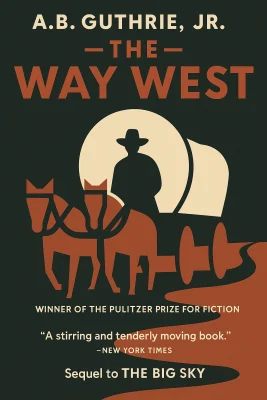
The Way West
Categories
Fiction, Classics, Audiobook, Historical Fiction, Literature, Westerns, American, Historical, Novels, Adventure
Content Type
Book
Binding
Paperback
Year
2002
Publisher
Mariner Books Classics
Language
English
ASIN
0618154620
ISBN
0618154620
ISBN13
9780618154623
File Download
PDF | EPUB
The Way West Plot Summary
Introduction
# Westward Bound: An American Odyssey on the Oregon Trail The Missouri morning hung thick with mist and possibility as Lije Evans stood watching the muddy road that led away from everything he'd ever known. Behind him, Rebecca moved through their kitchen with practiced efficiency, but her mind was already following that road westward, toward a word that had begun to taste like freedom on both their tongues: Oregon. The fever was spreading through Independence like wildfire, drawing families from their settled lives with promises of free land beyond the mountains, where a man could build something lasting for his children. In the gathering crowds outside Hitchcock's store, destiny took shape in the form of wagon wheels and ox teams. There was Tadlock, the sharp-faced politician with his guidebook certainties, and Dick Summers, the grizzled mountain man whose gray eyes held secrets of untamed valleys. Twenty-two families bound together by shared madness and mutual need, calling themselves the On-to-Oregon Outfit though Oregon still lay impossibly distant beyond the western horizon. They would learn the cruel arithmetic of survival together, discovering that the trail demanded payment in blood and tears for every mile of progress toward the promised land.
Chapter 1: The Call of Oregon: Dreams and Departures from Missouri
The wagons rolled out of Independence like a white-topped serpent, their wheels cutting familiar Missouri mud for the last time. Lije Evans walked beside his oxen while Rebecca perched on the wagon seat, their seventeen-year-old son Brownie somewhere back with the cattle herd that trailed the column like a dusty afterthought. The first days taught them that miles which seemed nothing on a map stretched into eternities of jolting wheels and aching backs. Tadlock commanded the train with the bearing of a courthouse politician, his square shoulders and confident voice marking him as a natural leader. But Dick Summers, riding point with his rifle across his saddle, seemed more concerned with the practical realities of moving a small town across an empty continent. The old mountain man had traveled this route when it belonged only to Indians and trappers, before the great migration began carving permanent scars across the wilderness. The Kaw River crossing came like baptism by muddy water. Wagons floated on hastily lashed logs while curious Kaw Indians splashed alongside in their dugout canoes, some emigrants watching with naked fear as if expecting war whoops at any moment. But the real enemy revealed itself slowly: not Indians or wild beasts, but the simple grinding reality of distance itself. Axles broke on hidden rocks, oxen went lame on rough ground, and children fell sick with mysterious fevers while their mothers learned to cook over buffalo chips when wood became scarce. At night, when the wagons formed their protective circle and fires flickered like fallen stars, the emigrants shared their dwindling supplies of hope. Some spoke of turning back, but the words felt hollow. They had already traveled too far to retreat, though Oregon still shimmered beyond the western horizon like a mirage that receded with every step forward into the unknown.
Chapter 2: Leadership Forged: Crisis and Command on the Early Trail
The trouble had been building for weeks, invisible as a hairline crack in a wagon wheel until the moment it split apart completely. Martin, Tadlock's hired hand, fell sick with camp fever near Brady's Island, his body burning with illness while Tadlock insisted the train must roll. One sick man couldn't delay thirty families, the captain declared with the harsh pragmatism of a courtroom lawyer. But Lije Evans, looking at Martin's fevered face, saw the moment when leadership becomes tyranny. "We ain't goin' to jolt him along in a wagon," Evans said quietly, and in those words lay a challenge that split the company like an ax splitting wood. The confrontation drew battle lines through the emigrant circle. Some sided with Tadlock's efficiency, others with Evans' stubborn compassion. When the council met to decide, even Tadlock's supporters abandoned him. Curtis Mack, the troubled merchant from Buffalo, cast the deciding vote with visible reluctance. The election that followed felt almost anticlimactic. Evans was chosen not because he sought power, but because power had sought him and found him worthy. He accepted the responsibility with the same quiet determination that had made him challenge Tadlock, knowing that leadership was not a prize to be won but a burden to be carried. Tadlock's face darkened with defeat, but he remained with the train, his ambition temporarily checked but not extinguished. Martin died before dawn, and they buried him in unmarked ground while the new captain wondered if he would prove any wiser than the man he had replaced. The democratic ideals that had seemed so noble in Independence began to wither under the harsh sun of consequence, teaching the emigrants their first lesson in the brutal mathematics of survival.
Chapter 3: Rivers of Trial: Crossing Waters and Confronting Mortality
The Platte River ran like liquid desert, too thick to drink and too thin to plow, carrying the dreams of emigrants westward on its muddy current. For hundreds of miles it would be their companion and torment, a highway that led toward the mountains but offered little comfort along the way. The water tasted of alkali and buffalo dung, and the wind that followed the river valley carried dust that settled in every crease of clothing, every line of weathered faces. Death came to the wagon train with quiet persistence. First Martin, burning with fever in the pre-dawn darkness. Then little Tod Fairman, five years old and bright as a new penny, who wandered from his mother's washbasin to chase a grasshopper and found instead a rattlesnake coiled among the rocks near Independence Rock. The bite was swift, the dying slower. Tod's leg swelled to twice its normal size, flesh turning black with poison while his parents watched in helpless agony. Judith Fairman, who had brought her son west to escape Kentucky's fevers, now held his small hand and whispered promises she knew she couldn't keep. Dick Summers tried what remedies he knew, chewing roots the Sioux had taught him to use, but the poison was stronger than any medicine. The emigrants gathered around the tent in awkward silence, offering what comfort they could while Brother Weatherby spoke of God's mysterious ways and heavenly mansions. They buried Tod beside the Sweetwater River, in a grave deep enough to keep the wolves away. The service was brief: a prayer, a hymn that sounded frail against the wind, the hollow sound of earth falling on wood. Then the train moved on, because that was what trains did, leaving another small mound of stones to mark where hope had died and been buried in the unforgiving ground.
Chapter 4: The Weight of Distance: Personal Struggles on the Great Plains
The trail was a crucible that stripped away comfortable pretenses to expose raw humanity beneath. Curtis Mack, the merchant from Buffalo, carried his own private torment: a marriage grown cold, a wife who turned from him in their tent while he burned with needs she could not satisfy. His hunger drove him to seek comfort in the arms of Mercy McBee, a sixteen-year-old girl whose beauty bloomed like a wildflower in the harsh landscape of her family's poverty. Their affair was conducted in stolen moments: walks by the river, meetings in the shadow of Independence Rock while fiddle music drifted from the emigrants' dance. Mercy gave herself with the desperate trust of youth, believing love could transform the brutal realities of her existence. But Mack, for all his tenderness, was a married man caught between the girl who offered passion and the wife who withheld it. Young Brownie Evans watched from the margins, his seventeen-year-old heart breaking with each smile Mercy gave to the older man. He carved their names together on Independence Rock, a declaration of love that existed only in his imagination, while the object of his affection lay in another man's arms. The boy's pain was sharp and clean, untainted by the complexities that tormented Mack. Meanwhile, the practical business of survival continued. Wagons broke down and were repaired. Oxen went lame and were replaced or abandoned. The emigrants learned to read the sky for weather signs, to judge grass and water quality, to make a hundred small decisions that could mean the difference between life and death. They were becoming something new, shaped by distance and hardship into something harder than their former selves.
Chapter 5: Through Buffalo Country: Navigating Nature's Power and Peril
The buffalo came like a brown tide across the grassland, countless thousands moving in a migration as old as the continent itself. Nothing had prepared the emigrants for the reality: animals stretching to every horizon, their hoofbeats drumming like distant thunder, their voices raised in constant bellowing that seemed to shake the earth. For the wagon train, the herds meant both opportunity and mortal danger. Fresh meat was a blessing after weeks of salt pork, but a buffalo stampede could crush wagons and scatter livestock across hundreds of miles of empty prairie. Dick Summers, who had lived among the herds in his trapping days, watched the animals with wary respect. "They're like a river in flood," he told Evans. "Get caught in the current, and it'll carry you where it wants to go." The storm came at night, lightning splitting the darkness while thunder rolled across the plains. The buffalo, already nervous from the day's heat and the press of their own numbers, broke into a run that seemed to have no beginning and no end. Evans found himself standing in the path of the stampede, his rifle useless against the wall of flesh and horn bearing down on him. The sound was beyond description: not just noise but a physical force that seemed to stop the heart and paralyze the limbs. Somehow the main herd missed the wagon circle, flowing around it like water around a stone. But the emigrants' cattle, caught up in the panic, ran with the buffalo into the darkness. It took two days to gather the scattered animals, and even then they were short a dozen head. The men who rode out to collect the strays came back hollow-eyed and silent, marked by their glimpse of the raw power that still ruled the western plains. They had seen the face of the wilderness, and it was beautiful and terrible beyond human comprehension.
Chapter 6: Mountain Passages: The Final Test of Will and Endurance
The Snake River writhed through its canyon like a serpent of liquid malice, its waters running deep and treacherous between walls of black rock. Evans stood on the rim, looking down at the crossing that would test every ounce of skill and courage his people possessed. The river had claimed wagons and lives from previous trains, leaving scattered bones and broken dreams along its banks. Dick Summers studied the water with the eye of a man who had crossed every stream between the Missouri and the Pacific. His plan was simple in concept, terrifying in execution: they would ford the river at its deepest point, using the current's own power to carry them across. The oxen would swim, the wagons would float, and human will would bridge the gap between disaster and deliverance. The crossing became a ballet of controlled chaos. Teams of oxen plunged into the current, their drivers shouting encouragement while the river tried to sweep everything downstream. Mrs. Byrd's wagon overturned in the middle of the crossing, spilling its human cargo into the churning water. Evans dove in without hesitation, fighting the current to drag the unconscious woman to safety while her husband clung to the wagon's side. They lost livestock and supplies, but no lives. As the last wagon rolled up the western bank, Evans felt something shift in the emigrants' spirits. They had faced the Snake and survived. The Blue Mountains loomed ahead, their peaks touched with early snow, but the worst was behind them. Oregon lay just beyond those ridges, close enough now to taste in the wind that blew from the Pacific.
Chapter 7: Valley of Promise: Arrival in the Oregon Territory
The Columbia River spread before them like a highway paved with liquid silver, its broad waters carrying the promise of journey's end. From the heights above The Dalles, Evans could see the great river's path to the sea, winding through mountains that seemed to part like curtains revealing the final act of their long drama. The wagon wheels had carried them two thousand miles, but these last miles would be traveled by water. Dick Summers stood apart from the celebration, his weathered face turned eastward toward the mountains they had crossed. The mountain man had guided them faithfully to the edge of the promised land, but his heart remained with the wilderness they were leaving behind. When Evans woke the next morning, Summers was gone, vanished like morning mist, drawn back to a world that existed now only in memory and longing. The emigrants built crude boats from their wagon beds, lashing them to Indian canoes in a marriage of necessity and ingenuity. The Columbia carried them through the Cascade Mountains' towering walls, past waterfalls that fell like silver ribbons from impossible heights. At night they camped on narrow beaches, listening to the river's voice and dreaming of green valleys ahead. Fort Vancouver appeared around a bend like a vision from a fever dream: British flags flying over American hopes, but welcoming nonetheless. Beyond the fort's walls, the Willamette Valley stretched green and fertile under Oregon's gentle sky. Evans stood in the bow of his makeshift boat, Rebecca beside him, their son Brownie completing the family circle. Behind them came the other survivors of the great journey, their faces marked by hardship but brightened by achievement.
Summary
The Oregon Trail had taken its toll in blood and tears, claiming the weak and testing the strong with every mile of its punishing length. Tod Fairman lay buried beneath a cairn of stones near Independence Rock. Martin's bones whitened in an unmarked grave beside the Platte. Dick Summers had vanished back into the wilderness, choosing memory over progress. But the survivors had won something precious in return for their sacrifice: they had helped write the next chapter of American destiny with the iron rims of their wagon wheels. Lije Evans stood on the banks of the Willamette River, watching his oxen graze in belly-deep grass, and knew the gamble had paid off. The emigrants who had started as strangers in Independence were now bound together by shared suffering and common triumph. They had faced the wilderness and emerged victorious, carrying with them the seeds of civilization that would grow into cities and states. The westward wheels had stopped rolling, but the dream they carried would echo through generations yet unborn, a testament to the price of progress and the power of human will to overcome any obstacle in pursuit of a better tomorrow.
Best Quote
“امنح بعض الرجال بندقية وشيئا من السلطة، وسوف تراهم يقومون بتنفيذ الأوامر بعنجهية وغباوة.” ― A.B. Guthrie Jr., The Way West
Review Summary
Strengths: The review highlights the book's vivid depiction of the Oregon Trail journey, emphasizing the realistic portrayal of characters like Lije Evans and Dick Summers. The narrative's ability to convey both physical and emotional challenges is praised, as well as the depth of character development, particularly with Dick Summers, whose perspective resonates deeply with the reviewer. Overall: The reviewer expresses a strong positive sentiment towards the book, appreciating its historical authenticity and character depth. The narrative is recommended for its insightful exploration of the pioneer spirit and the complexities of human resilience and leadership.
About Author

A.B. Guthrie Jr.
Guthrie interrogates the realities of frontier life, vividly portraying the challenges and human endeavors of settlers in the American West. His literary approach combines historical accuracy with a profound respect for the land, prioritizing authentic depictions over romanticized narratives. Notably, his book "The Way West" earned him the Pulitzer Prize for Fiction in 1950, underscoring his ability to capture the essence of western expansion. Guthrie’s works often explore the settlement of the Far West along the upper Missouri and Columbia rivers, a theme that resonates with readers interested in the intricate tapestry of human and environmental interactions.\n\nGuthrie’s transition from journalism to literature allowed him to channel his keen observational skills into his novels, starting with "Murders at Moon Dance". This shift enabled him to delve into fiction and eventually integrate mystery elements, as seen in "Wild Pitch". Moreover, his experience as a screenwriter, particularly his Academy Award-nominated adaptation of "Shane", highlights his versatility in storytelling. Readers benefit from Guthrie's narratives that blend adventure with introspective commentary, providing both entertainment and a deeper understanding of American history. His works, including "The Big Sky" and "These Thousand Hills", appeal to those who appreciate complex character development and richly detailed settings.\n\nThroughout his career, Guthrie received numerous accolades, including the Western Heritage Wrangler Award and an honorary doctorate in literature. This recognition, along with his induction into the Montana Cowboy Hall of Fame, attests to his significant impact on both literature and cultural heritage. For those seeking a concise bio of this influential author, Guthrie’s legacy is evident in his compelling storytelling and his dedication to preserving the historical and natural landscapes of the American West.
Read moreDownload PDF & EPUB
To save this Black List summary for later, download the free PDF and EPUB. You can print it out, or read offline at your convenience.
The Way West
by A.B. Guthrie Jr.
