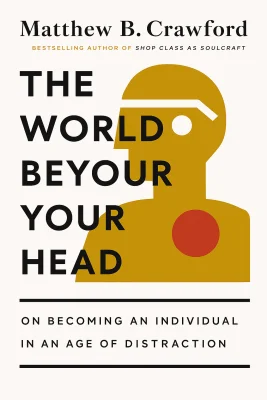
The World Beyond Your Head
On Becoming an Individual in an Age of Distraction
Categories
Nonfiction, Self Help, Psychology, Philosophy, Education, Technology, Audiobook, Sociology, Personal Development, Cultural
Content Type
Book
Binding
Hardcover
Year
2015
Publisher
Farrar, Straus and Giroux
Language
English
ASIN
0374292981
ISBN
0374292981
ISBN13
9780374292980
File Download
PDF | EPUB
The World Beyond Your Head Plot Summary
Introduction
We live in an age where our attention is increasingly fragmented, commodified, and manipulated by forces beyond our control. This crisis of attention raises profound questions about human agency and selfhood in contemporary society. What does it mean to be a self capable of meaningful action in a world designed to capture and monetize our awareness? How might we reclaim our capacity for sustained engagement with reality when surrounded by technologies engineered to distract us? The traditional liberal conception of autonomy—the idea of the self as a sovereign chooser standing apart from external influences—proves inadequate for addressing these challenges. By examining how attention operates through embodied practices, social relationships, and cultural traditions, we can develop a more realistic understanding of human agency. This perspective reveals that genuine freedom emerges not through isolation from external constraints but through skilled engagement with them. By situating attention within concrete practices and communities, we discover resources for resisting the forces that fragment our mental lives and undermine our capacity for meaningful action.
Chapter 1: The Crisis of Attention in Contemporary Culture
The contemporary crisis of attention manifests in our daily experience of fragmentation and distraction. We find ourselves constantly interrupted by notifications, unable to sustain focus on meaningful tasks, and increasingly dependent on digital devices that promise connection but deliver only fleeting engagement. This phenomenon extends beyond individual psychology to encompass broader cultural and economic transformations. Our attention has become a scarce resource in an information-saturated environment—perhaps the most valuable commodity in today's economy. Public spaces have been colonized by attention-capturing technologies that exploit our innate orienting response to novel stimuli. Airport terminals, doctor's waiting rooms, and even gas station pumps now feature screens broadcasting a continuous stream of content designed to command our awareness. This saturation of the visual field represents a kind of enclosure of the attentional commons—a privatization of cognitive resources that were once available for self-directed thought or social interaction. The very architecture of our shared spaces increasingly serves commercial interests rather than human flourishing. This crisis has historical roots extending back to the Enlightenment conception of the self as fundamentally separate from the world it perceives. By casting human experience as consisting primarily of mental representations, modern philosophy laid the groundwork for treating attention as something manipulable and engineerable. When reality is understood as a construction within the mind rather than something we directly encounter, the door opens to increasingly sophisticated techniques for managing and directing that construction process. The problem extends beyond unwanted intrusions to include the positive attractions of our attentional environment. Digital platforms employ sophisticated psychological techniques to maximize engagement, creating what some researchers call "supernormal stimuli"—experiences more compelling than anything found in nature. Just as processed foods override our natural satiety mechanisms, these technologies bypass our cognitive self-regulation, leaving us perpetually craving more stimulation regardless of its nutritional value for our mental lives. This situation threatens not just our productivity but our very capacity for self-determination. When our attention is constantly captured by external forces, we lose the ability to direct our awareness according to our own values and purposes. The result is a kind of dispossession—a loss of ownership over our mental lives that undermines the possibility of coherent selfhood and meaningful agency. The crisis of attention thus reveals itself as fundamentally a crisis of freedom in the contemporary world.
Chapter 2: Embodied Cognition: How We Engage with the World
Human cognition is fundamentally embodied, extending beyond the boundaries of our skulls to incorporate our physical bodies and the environments we inhabit. This perspective challenges the Cartesian view of mind as an immaterial substance merely observing the world from a distance. Instead, perception and thought emerge through active engagement with our surroundings. We don't simply receive sensory data and construct internal models; we explore and manipulate the world directly through our bodies. This embodied approach transforms our understanding of skilled practices. Consider a hockey player's relationship with his stick. Through thousands of hours of practice, the stick becomes effectively transparent—an extension of the player's body rather than an external object requiring conscious manipulation. The player doesn't need to think about the stick; he thinks through it, directly perceiving opportunities for action on the ice. This integration happens through what philosopher Michael Polanyi called a shift in awareness from "attending to" the tool itself to "attending from" it toward the world. Our perception is intimately bound up with our capacity for action. Psychologist James Gibson developed this insight through his concept of affordances—the possibilities for action that objects in our environment present to us. A chair affords sitting for a human being of a certain size, regardless of whether anyone is currently sitting in it. These affordances aren't subjective projections but real properties of objects in relation to an agent's capabilities. Importantly, what affordances we perceive depends not just on our physical bodies but on our acquired skills and practices. This skill-dependent perception explains why experts literally see the world differently than novices. A master chess player doesn't methodically analyze each possible move but immediately perceives meaningful patterns and promising possibilities. Similarly, an experienced mechanic hears subtle variations in engine sounds that remain imperceptible to untrained ears. These differences in perception aren't merely interpretive but arise at the most fundamental level of sensory experience. Skill transforms not just what we think about the world but how we encounter it. The embodied nature of cognition has profound implications for understanding human agency. If perception and thought are inseparable from bodily action, then freedom cannot consist in transcending our physical nature. Instead, genuine agency emerges through the development of embodied skills that expand our capacity to engage meaningfully with the world. A skilled craftsperson doesn't overcome material constraints but develops a refined sensitivity to them, discovering possibilities for beautiful action within the world as it is. This perspective suggests that our current attentional crisis stems partly from technologies that abstract us from embodied engagement with reality. Digital interfaces often reduce rich multisensory interactions to visual information on screens, diminishing the role of tactile feedback and bodily movement in cognition. By understanding attention as fundamentally embodied, we can better appreciate what is lost when our mental lives become increasingly disembodied and how we might reclaim more integrated forms of engagement with the world.
Chapter 3: The Myth of Autonomy and Its Consequences
The modern ideal of autonomy—complete independence from external determination—has profoundly shaped our understanding of freedom and selfhood. This conception, crystallized in Kant's moral philosophy, posits that true freedom requires transcending all contingent circumstances and acting according to universal principles accessible to pure reason. The autonomous self is one that gives laws to itself, unconstrained by material conditions or social influences. This ideal has become so deeply embedded in our cultural psychology that we rarely question its assumptions or implications. We value the appearance of self-determination so highly that we often resist acknowledging the ways our choices are shaped by our environments. This resistance creates a significant blind spot: we fail to recognize how our attention is being manipulated precisely because we cling to the fiction of ourselves as sovereign choosers standing apart from external influences. The consequences of this blind spot are evident in contemporary children's entertainment. Consider the contrast between old Mickey Mouse cartoons and current programming like Mickey Mouse Clubhouse. The early cartoons derived humor from the mouse's struggles with recalcitrant objects—fold-down beds that wouldn't stay down, waves that wouldn't stop coming, elastic bands that snapped back unexpectedly. These cartoons acknowledged the fundamental condition of being embodied in a material world that resists our will. By contrast, Mickey Mouse Clubhouse presents a world where technology magically conforms to human desires. When problems arise, characters summon the "Handy Dandy Machine," which presents a menu of tools guaranteed to solve any situation. No moment of helplessness is permitted; no deep conflict between will and world exists. This fantasy of frictionless agency through technological mediation reflects our culture's increasing discomfort with material constraints and embodied limitations. This discomfort extends to our relationship with other people, who represent the most significant "constraint" on pure autonomy. Digital technologies increasingly allow us to interact with others through representations that are more contained and controllable than face-to-face encounters. As Sherry Turkle's research shows, many people prefer texting to calling because it allows them to craft a more perfect self-presentation. Real-time interaction demands a kind of vulnerability and responsiveness that threatens the ideal of complete self-determination. The irony is that this pursuit of autonomy ultimately undermines genuine agency. By insulating ourselves from the world's resistance through layers of technological mediation, we lose the very friction necessary for developing meaningful skills and capacities. Just as muscles require resistance to grow stronger, human agency develops through engagement with constraints rather than their absence. The myth of autonomy thus leads paradoxically to a diminished form of selfhood—one increasingly dependent on technological scaffolding and increasingly incapable of sustained engagement with reality on its own terms.
Chapter 4: Skilled Practices as Models for Meaningful Agency
Skilled practices offer an alternative model of human agency—one that acknowledges our embeddedness in material and social contexts while preserving a meaningful sense of freedom. Consider a short-order cook during the breakfast rush. As orders pile up, the cook establishes an ecology of attention where external demands provide loose structure within which he creates an internal order of smooth, adaptive action. He arranges ingredients spatially to correspond with their temporal sequence in cooking, encodes heat levels through the placement of pans, and develops rhythmic patterns of movement that maximize efficiency. This skilled performance doesn't represent freedom from constraints but freedom through engagement with them. The cook doesn't transcend the physical limitations of his environment; he incorporates them into his cognitive process, using the arrangement of objects as external memory and the properties of materials as guides for action. His agency emerges not despite these constraints but because of his intimate familiarity with them. The busier the kitchen gets, the more "on fire" he feels—not overwhelmed but energized by the challenge of coordinating multiple tasks within established parameters. Such skilled practices involve what cognitive scientists call "extended cognition"—the offloading of mental processes onto environmental structures. We reach for pencil and paper when multiplying large numbers, use shopping lists to extend our memory, and arrange workspaces to support complex sequences of action. These aren't mere conveniences but fundamental aspects of human intelligence. Our cognitive capacities are inseparable from the cultural tools and practices through which we exercise them. This perspective transforms our understanding of freedom. Rather than seeing external influences as threats to autonomy, we recognize how certain kinds of structure enable rather than constrain meaningful action. A jazz musician's freedom doesn't come from transcending all rules but from mastering a tradition so thoroughly that creative possibilities emerge within its structures. Similarly, a motorcycle racer's freedom of movement depends on developing a deep attunement to physical constraints like traction and momentum. The development of skill involves a progression from explicit rule-following to embodied know-how. A novice driver consciously monitors each action—checking mirrors, signaling, pressing pedals—while an experienced driver performs these operations seamlessly, attention free to focus on navigating traffic. This progression represents not a loss of agency but its fulfillment. The skilled practitioner doesn't need to consciously control each movement because the relevant distinctions and responses have been incorporated into their perceptual and motor systems. This model of agency has significant implications for education and work design. If meaningful freedom emerges through skilled engagement with structured environments, then we should focus on creating contexts that support the development and exercise of skill rather than maximizing abstract choice. This means attending to the quality of our attentional ecology—designing spaces and technologies that enable rather than undermine our capacity for sustained engagement with worthwhile objects of attention.
Chapter 5: Joint Attention: The Social Dimension of Consciousness
Our mental lives are fundamentally social, shaped by our capacity for joint attention—the ability to attend to objects together with others while mutually aware of each other's attention. This capacity emerges in infancy around twelve months of age, coinciding with the development of declarative pointing and language acquisition. Through joint attention, we are initiated into a world already saturated with meaning, learning not just what to attend to but how to attend appropriately within our cultural context. This social dimension of consciousness challenges the individualist epistemology that has dominated Western thought since Descartes. We don't first perceive raw sense data and then interpret it; rather, we encounter a world already structured by social practices and conventions. Even seemingly basic perceptions like seeing a uniformly colored wall or hearing a ventilation system are informed by our participation in shared forms of life. Our most private experiences are shaped by public concepts and categories. The tools we use similarly embed social norms and practices. Chopsticks aren't just implements for an isolated individual; they belong to an "equipmental whole" that includes bowls rather than plates, sticky rice rather than peas, and particular dining practices. Our perception of objects is thus always already informed by their place within social practices. We see things not simply as physical entities but as bearers of cultural significance and practical possibilities. This social foundation of perception has implications for how we understand individuality. If our consciousness is fundamentally shaped by others, how do we develop as distinct individuals? The answer isn't to deny our social embeddedness but to recognize that genuine individuality emerges through particular kinds of social interaction—especially those involving confrontation and justification. We become individuals not by escaping social influence but by engaging with others in ways that require us to articulate and defend our perspectives. Hegel captured this dynamic in his account of self-knowledge. For Hegel, one knows oneself by one's deeds—actions that are inherently social in that their meaning depends on how others receive them. The problem of self-knowledge is largely how we make ourselves intelligible to others through actions, receiving back a reflected view of ourselves. There is no self to be known that exists prior to the self that is in the world. This implies that individuality is something achieved only through dealings with others. This social conception of selfhood offers resources for addressing our contemporary crisis of attention. If attention is fundamentally social, then the solution to its fragmentation may lie not in individual discipline but in creating contexts for joint attention around worthwhile objects. Communities of practice—whether scientific laboratories, artistic workshops, or athletic teams—provide structured environments where attention is directed and sustained through shared commitment to excellence in a particular domain. Such communities offer an alternative to both isolated individualism and mass conformity.
Chapter 6: Tradition as a Resource for Innovation
Contrary to Enlightenment assumptions, tradition can be a source of progress rather than an impediment to it. This becomes evident when we examine communities of skilled practice like organ making. At Taylor and Boody, a pipe organ workshop in Virginia's Shenandoah Valley, craftspeople engage in a dialectical relationship with their tradition that is simultaneously reverent and critical. They study historical instruments, reverse-engineering them to recover techniques and principles developed over centuries. But they don't slavishly copy the past; they interrogate it, asking why certain materials and methods were used and whether they remain appropriate in current circumstances. Their historical inheritance doesn't burden these craftspeople but energizes their innovation. They intend for their organs to be in use four hundred years from now, which requires critical engagement with past designs. Their progress in skill and understanding represents a deepening of the craft itself, not a break from tradition. This model challenges our modern concept of creativity as creation ex nihilo—a godlike act of bringing something from nothing. Instead, it suggests that creativity emerges through engagement with existing forms and practices. This perspective has implications for education. Learning begins not with autonomous judgment but with submission to authority—the authority of teachers who embody a tradition of practice. Through this submission, students gradually develop the capacity for independent judgment within the standards of excellence defined by the practice. This process involves what philosopher Alasdair MacIntyre calls the "narrative unity" of a human life—the way our current activities gain meaning through their place in a larger story connecting past and future. The organ makers understand their inventiveness as "going further" in a trajectory they have inherited, connecting them to a community that extends across time. This temporal dimension of skilled practice contrasts sharply with the presentism of contemporary culture, where innovation is often equated with novelty and disruption rather than development and refinement. By recovering a sense of ourselves as inheritors of traditions, we gain resources for resisting the fragmentation of attention that characterizes modern life. This approach offers a path beyond the false dichotomy between traditionalism and progressivism. It suggests that genuine innovation emerges not from rejecting inheritance but from engaging critically with it. Similarly, it transcends the opposition between individualism and collectivism by showing how true individuality develops through participation in communities of practice with shared standards of excellence. The organ maker achieves distinctiveness not by standing apart from tradition but by contributing to its ongoing development. The concept of tradition as a resource for innovation also applies to our relationship with technology. Rather than uncritically embracing each new technological development or reactively rejecting all innovation, we might ask how new technologies can be integrated into existing practices in ways that enhance rather than undermine human flourishing. This requires attending to the specific qualities of different technologies and their compatibility with the goods internal to various practices.
Chapter 7: Reclaiming the Real: An Ethics of Attention
An ethics of attention would focus on reclaiming the real—both in our encounters with things and with other people. This means resisting the tendency toward abstraction that characterizes much of contemporary culture, where reality is increasingly mediated through representations designed to make the world innocuous to a fragile ego. The narcissistic personality needs constant support and is unclear on the boundary between self and other. It "cannot tolerate the complex demands of other people but tries to relate to them by distorting who they are and splitting off what it needs." Engaging with material reality involves accepting its resistance to our will—what might be called "negative affordances." The skilled practitioner doesn't seek to escape these constraints but develops a refined sensitivity to them. There's a kind of wonder and gratitude in discovering the possibilities for beautiful action within the world as it is—like a surfer finding that the rules of gravity and buoyancy make riding waves possible. This attitude stands in stark contrast to the fantasy of frictionless agency through technological mediation. Similarly, encountering other people as real requires moving beyond abstract egalitarianism toward a recognition of concrete excellence. Our attraction to human superiority—most evident in sports—can actually connect us to others in genuine ways if we're attentive to the diverse forms excellence can take. We might find admirable skill in unexpected places: the cognitive finesse of a short-order cook or the diagnostic intelligence of a mechanic. This attention to rank—the well-earned kind—doesn't threaten democratic commitments but grounds them in reality rather than abstraction. The philosopher Iris Murdoch offers guidance for this ethics of attention. She suggests that when disturbed by unwanted emotions like resentment or jealousy, "pure will" can achieve little. What's needed is "a reorientation which will provide an energy of a different kind, from a different source." This reorientation comes through attending to real objects that interest us. The solution isn't willpower but a shift of attention toward something worthy of our engagement—something that pulls us out of self-absorption into genuine connection with reality. This approach differs from David Foster Wallace's strategy of consciously reinterpreting irritating situations through generous imagination. Wallace recommends imagining that the SUV driver who cut you off might be rushing a child to the hospital. But this remains within the paradigm of mental representation—constructing scenarios to serve psychological needs rather than attending to reality itself. Murdoch's therapy is predicated on realism: new energies come from real objects that interest us. You abandon the tormenting object, walking away because your energies focus elsewhere. Education, too, would benefit from reclaiming the real. As woodshop teacher Doug Stowe observes, "Without the opportunity to learn through their hands, the world remains abstract and distant, and the passions for learning will not be engaged." This suggests that education should reconnect with embodied practice, recognizing that most humans aren't naturally scholars but learn best through engagement with concrete realities. By grounding learning in skilled practices that bring students into direct contact with the material world, we might cultivate forms of attention resistant to the fragmentation characteristic of contemporary culture.
Summary
The crisis of attention we face stems not simply from technological developments but from deeper cultural assumptions about the self and its relationship to the world. By reconceiving the self as situated—embedded in material environments, social practices, and historical traditions—we can develop a more realistic understanding of human agency and freedom. This situated perspective doesn't diminish human dignity but enriches it by reconnecting us to the real sources of meaning and value in our lives. This approach offers a path beyond the false dichotomies that structure much contemporary discourse. It transcends the opposition between individualism and collectivism by showing how true individuality develops through participation in communities of practice with shared standards of excellence. It moves beyond the conflict between tradition and innovation by revealing how creative development emerges through critical engagement with inheritance. And it challenges the assumed tension between freedom and constraint by demonstrating how meaningful agency emerges through skilled engagement with the world's resistance rather than its absence. By attending to the concrete realities of skilled practice and embodied perception, we can recover a more humane and realistic understanding of what it means to be a self in the world.
Best Quote
“Think of the corporate manager who gets two hundred emails per day and spends his time responding pell-mell to an incoherent press of demands. The way we experience this, often, is as a crisis of self-ownership: our attention isn’t simply ours to direct where we will, and we complain about it bitterly. Yet this same person may find himself checking his email frequently once he gets home or while on vacation. It becomes effortful for him to be fully present while giving his children a bath or taking a meal with his spouse. Our changing technological environment generates a need for ever more stimulation. The content of the stimulation almost becomes irrelevant. Our distractibility seems to indicate that we are agnostic on the question of what is worth paying attention to—that is, what to value.” ― Matthew B. Crawford, The World Beyond Your Head: On Becoming an Individual in an Age of Distraction
Review Summary
Strengths: The review highlights the author's ability to engage with profound themes such as excellence, work, and education. It appreciates Crawford's exploration of attention and the necessity of genuine human interaction, as well as his challenge to philosophical norms by emphasizing the importance of environment and community in shaping the individual.\nOverall Sentiment: Enthusiastic\nKey Takeaway: Matthew B. Crawford's book, "The World Beyond Your Head," is praised for its insightful examination of how individuals can transcend distractions and foster genuine connections through interaction with the world and others, challenging traditional philosophical views on individuality and morality.
About Author

Matthew B. Crawford
Crawford bridges the gap between manual labor and philosophical discourse, offering a unique perspective on the intrinsic value of skilled manual work. Through his critically acclaimed books, such as "Shop Class as Soulcraft" and "The World Beyond Your Head," Crawford critiques contemporary society's emphasis on white-collar professions, advocating instead for the fulfillment found in manual trades. His work interrogates how modern distractions undermine individual autonomy, urging readers to reclaim attention and focus amidst technological chaos. By weaving his experiences as a philosopher and mechanic, Crawford's method offers a profound critique of progress narratives that overlook the merits of craftsmanship.\n\nHis writing style, noted for its erudition and accessibility, blends philosophical insights with relatable anecdotes from his personal life, thus providing a rich tapestry for exploring his major themes. Readers are encouraged to engage more mindfully with the world, recognizing the value of craftsmanship and the pitfalls of technocratic governance. Those interested in the intersection of culture, philosophy, and work will find Crawford's bio illustrative of a thinker who champions the agency and autonomy afforded by hands-on labor. This perspective is particularly relevant for those seeking deeper meaning in an age dominated by digital abstraction and automation.\n\nCrawford's contributions to contemporary thought extend beyond his books, earning him recognition as a public intellectual and philosopher. His insights into the philosophy of work, attention, and autonomy challenge the reader to reconsider modern productivity paradigms. His notable appearances and writings across diverse platforms reflect his influential role in sparking dialogue around the human condition in an era of distraction.
Read moreDownload PDF & EPUB
To save this Black List summary for later, download the free PDF and EPUB. You can print it out, or read offline at your convenience.
The World Beyond Your Head
by Matthew B. Crawford
