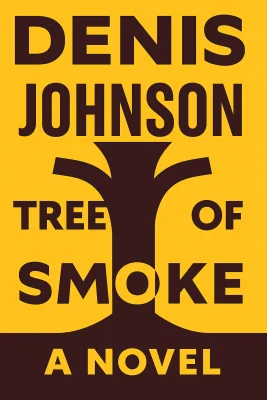
Tree of Smoke
Categories
Fiction, Audiobook, Historical Fiction, Literature, American, Historical, Contemporary, Novels, War, Literary Fiction
Content Type
Book
Binding
Hardcover
Year
2007
Publisher
Farrar, Straus and Giroux
Language
English
ASIN
0374279128
ISBN
0374279128
ISBN13
9780374279127
File Download
PDF | EPUB
Tree of Smoke Plot Summary
Introduction
# Tree of Smoke: Souls Lost in War's Labyrinth of Deception The monkey's tears mixed with the morning rain as Seaman William Houston Jr. cradled the dying creature in his hands, watching its small heart flutter to a stop. He had shot it for no reason at all, standing in the Philippine jungle on the morning after President Kennedy's assassination, and now he wept like a child over this senseless act of violence. The creature had looked at him with such careful attention as it died, as if following some invisible conversation between the jungle and the moment itself. This single act of cruelty ripples through Denis Johnson's sprawling epic of America's longest war, connecting the fates of soldiers, spies, and civilians caught in the machinery of a conflict that would consume a generation. At the center stands Colonel Francis Sands, a legendary intelligence officer whose mysterious Tree of Smoke operation promises to unlock the secrets of psychological warfare, and his nephew Skip, a young CIA operative who discovers that in Vietnam, the most dangerous enemies often wear friendly faces. In the steaming jungles where truth dissolves like morning mist and loyalty becomes a currency traded in blood, these men will learn that some wars are fought not just for territory, but for the human soul itself.
Chapter 1: Innocence in the Shadow: Young Americans Enter the War
Skip Sands stepped off the transport plane into the furnace heat of Southeast Asia, his crisp uniform already wilting in humidity that felt thick enough to drink. At twenty-four, he carried himself with the eager confidence of a Harvard graduate who believed intelligence and good intentions could win any war. The CIA had recruited him for his languages and his lineage—his uncle Francis was already a legend in these shadow operations. Colonel Francis Xavier Sands emerged from the jungle like a force of nature, his gray crew cut and boulder-like build commanding instant respect. He had survived Japanese prison camps, fought with the Flying Tigers, and now ran psychological warfare operations that existed in the gray spaces between official policy and necessary action. When he gripped Skip's hand at their first meeting, the young operative felt the weight of history and expectation pressing down on him like the tropical air. Meanwhile, in the mountain town of Damulog on Mindanao, Skip encountered Kathy Jones, a Canadian nurse whose missionary husband had vanished into the jungle months earlier. Their first meeting crackled with electric recognition and desperate need. Kathy had thrown herself at a stranger in a restaurant, mistaking Skip for her missing husband in the candlelight, and the encounter left both of them shaken by forces they couldn't name or control. The colonel's domain sprawled across multiple countries, a shadow empire of safe houses, informants, and operations that defied conventional military structure. He spoke of the enemy not as faceless communists but as worthy adversaries in a chess game played across continents. His philosophy was simple: in unconventional warfare, conventional rules were suicide. Skip listened with the fascination of a student discovering his true calling, unaware that his education in betrayal had already begun.
Chapter 2: The Colonel's Vision: Psychological Warfare and Sacred Missions
The Tree of Smoke operation unfolded like a fever dream of deception and misdirection. Colonel Sands had conceived it as the ultimate psychological warfare campaign—a vast network of false intelligence designed to confuse and misdirect enemy forces. Documents would be planted, agents turned, and entire fictional military units created to exist only in the minds of communist planners. The beauty lay in its complexity, each false thread woven into a tapestry of lies so intricate that even its creators sometimes lost track of what was real. Skip found himself managing safe houses and coordinating with assets whose true loyalties remained perpetually in question. In the steaming heat of Cao Phuc, he established his base of operations in a villa that had belonged to a French doctor killed exploring Vietcong tunnels. The dead man's possessions remained exactly as he had left them—books scattered on his desk, pipes in their rack, shoes lined up by the door like sentries waiting for their owner's return. The colonel's methods were a mixture of legitimate counterinsurgency techniques and half-baked schemes born from his obsession with mythology and folklore. He organized film screenings in rural villages, showing propaganda movies about President Kennedy's life and death to audiences who couldn't understand the narration and fled when the generator's noise attracted enemy attention. He distributed leaflets designed to exploit local superstitions, but the psychological impact was undermined by poor translation and cultural misunderstanding. As months passed, Skip began to notice inconsistencies in the colonel's reports, gaps in the intelligence chain that suggested operations within operations. The Tree of Smoke seemed to be growing beyond its original parameters, developing branches and roots that extended into territories no one had mapped. When Skip raised questions, the colonel's eyes would take on a distant quality, as if he were seeing patterns invisible to others. The student was beginning to realize that his teacher might be playing a game whose rules no one else understood.
Chapter 3: Web of Lies: Double Agents and the Art of Deception
Trung Than lived in the spaces between certainties, a man whose survival depended on his ability to convince multiple masters of his loyalty. To the Viet Cong, he remained a dedicated revolutionary temporarily playing the long game. To Colonel Sands, he was a valuable asset providing crucial intelligence about enemy operations. To Skip, he became something more complex—a mirror reflecting the moral ambiguities that defined their shadow war. The colonel's faith in Trung seemed absolute, but Skip detected undercurrents of suspicion in their interactions. During late-night briefings in smoke-filled rooms, the colonel would probe Trung's information with questions that seemed designed to test consistency rather than gather intelligence. Trung responded with the practiced ease of a man accustomed to such scrutiny, his answers always plausible, always useful, always leaving room for doubt. Nguyen Hao served as the crucial intermediary, carrying messages between Trung and his American handlers while maintaining the fiction of loyalty to both sides. In the basement of a Saigon language school, Hao sat across from pale Americans who sweated through their shirts as they asked questions about his oldest friend. The recruitment process unfolded with agonizing slowness, each meeting a delicate dance of revelation and concealment. Skip's own role evolved from simple case officer to something approaching confessor. Agents brought him their fears, their doubts, their desperate need for someone to believe their stories. He learned to read the subtle signs that distinguished truth from fabrication, though in this war, the distinction often proved meaningless. What mattered was not whether information was true, but whether it was useful. The psychological toll began to show in small ways—Skip found himself questioning every conversation, analyzing every gesture for hidden meanings.
Chapter 4: Moral Descent: Trust Dissolving in Blood and Betrayal
The unraveling began with a polygraph test that felt more like an interrogation. Skip found himself strapped to machines designed to detect lies while Agency investigators probed his loyalty with surgical precision. They knew about discrepancies in the Tree of Smoke operation, about intelligence that had somehow found its way to enemy hands, about the colonel's increasingly erratic behavior. Skip's protestations of ignorance rang hollow even to his own ears. Captain Terry Crodelle emerged as Skip's primary antagonist, a by-the-book operator who viewed the colonel's freelance methods as dangerous insubordination. During their confrontations at the Green Parrot restaurant, Crodelle painted a picture of rogue operations and unauthorized activities that threatened to expose the entire intelligence network. Skip defended his uncle with the desperation of a man watching his world collapse, but doubt had already taken root in his mind like a cancer. The betrayal cut deeper than any enemy bullet when Skip realized someone had been feeding information to his interrogators, someone close enough to know the intimate details of the colonel's work. When he saw Hao walking past the interrogation room, the pieces fell into place with sickening clarity. Hao's position had become impossible—caught between American handlers who demanded results and Vietnamese cadres who suspected his loyalty, he had chosen survival over friendship. Meanwhile, Father Thomas Carignan floated face-down in a Mindanao river, an eight-inch dart from a Moro blowgun protruding from his neck. Skip had watched the old priest's spiritual desolation in his final days, listened to his confessions of wandering in a maze where he might become lost forever. The priest's murder marked Skip's true initiation into the world of intelligence work, where moral certainties dissolved in a fog of competing loyalties and hidden agendas.
Chapter 5: The Fall: Death of Warriors and Collapse of Operations
The colonel's death came suddenly, reported as a heart attack at a Saigon hotel. Skip knew better—in their world, natural deaths were rare commodities. Whether the colonel had been eliminated by his own side or the enemy hardly mattered. What mattered was that his death left Skip exposed, vulnerable to those who saw him as either a liability or a scapegoat. The Tree of Smoke operation died with its creator, its secrets buried with the man who had conceived it. The news reached Skip through Jimmy Storm's barely legible scrawl, delivered like a death certificate wrapped in profanity and rage. Storm, the wild-eyed sergeant who had served as the colonel's most devoted disciple, raged against the betrayal, convinced that Hao's information had led to their leader's capture and execution. Skip felt only numbness, the peculiar emptiness that comes when a fundamental certainty vanishes from the world. In the days that followed, competing narratives emerged about the colonel's final moments. Some claimed he had been tortured to death by Vietcong interrogators. Others suggested he had been killed by the brother of his Vietnamese mistress in a crime of passion. The most persistent rumor, whispered by those who had known him best, was that he had faked his own death as the ultimate deception operation, that somewhere in the delta he was still fighting his private war. The colonel's death sent shockwaves through the small community of true believers who had followed him into the labyrinth of unconventional warfare. His passing marked the end of an era, the final collapse of the romantic notion that individual heroism could triumph over institutional failure. Skip was left to contemplate the wreckage of dreams and the bitter knowledge that in a war built on lies, even death could be a deception.
Chapter 6: Exile and Pursuit: Running from the Ghosts of War
Skip's escape from custody became a desperate flight through a landscape he thought he knew. Every safe house might be compromised, every contact potentially turned against him. He made his way to the villa in Cao Quyen, where he burned the colonel's files and prepared for whatever judgment awaited him. When Crodelle arrived with money and a passport, Skip understood that his government was offering him a choice: disappear quietly or face the consequences of his uncle's sins. The decision was easier than he expected—loyalty to a dead man meant nothing compared to the possibility of survival. Skip's exile took him through a series of identities and occupations, each more removed from his original purpose than the last. He became William Benét, a Canadian businessman dealing in questionable commodities across Southeast Asia. The skills the CIA had taught him proved useful in less legitimate enterprises—arms dealing, smuggling, the kind of work that existed in the margins between legal and illegal. In the Philippines, he established a new life with a local woman named Cora and her children, finding in their simple domesticity a peace he had never known during his government service. But the past had a way of reasserting itself, and Skip discovered that his uncle's death had been only the beginning of a larger reckoning. The Tree of Smoke operation had left casualties and loose ends that someone was methodically cleaning up. Trung Than had survived the war's end, but his position as a double agent made him a liability to all sides. When Skip learned that his former asset was being hunted by the very people who had once employed him, he felt the weight of complicity in betrayals that stretched back years. The colonel's grand design had been built on the assumption that loyalty could be bought and sold like any other commodity, but the final accounting was written in blood.
Chapter 7: Final Judgment: Letters from the Gallows
In Pudu Prison, awaiting execution for arms trafficking, Skip finally found the clarity that had eluded him throughout his adult life. The concrete walls and iron bars stripped away the elaborate justifications he had constructed for his choices, leaving only the stark reality of consequences. He wrote letters to the few people who might remember him, trying to explain a life that defied easy explanation. His letter to Kathy Jones became a confession of sorts. He wrote about the colonel's true nature, about the operations that had sacrificed human lives for strategic advantage, about the moment when he had realized that patriotism and treachery were often indistinguishable. The words came slowly, each sentence a small act of penance for sins he could never fully catalog. The hunters had eventually found Skip in the jungles of Malaysia, where his arms dealing had finally attracted the wrong kind of attention. His arrest came not from American agents seeking to tie up loose ends, but from Malaysian authorities who cared nothing for the complexities of his past. In their eyes, he was simply another Western criminal who had chosen the wrong country for his final gambit. The execution itself was almost anticlimactic after the years of running and hiding. Skip faced the gallows with something approaching relief, understanding finally that some debts could only be paid with one's life. The Malaysian authorities were efficient and professional, treating him not as a former spy or a symbol of American imperialism, but simply as a condemned man whose time had run out. In the end, the Tree of Smoke had claimed all its creators and most of its participants, a web of betrayal and consequence that outlived the war it was meant to win.
Summary
The Vietnam War consumed a generation of Americans, but for men like Skip Sands and his uncle Colonel Francis, it offered something more seductive than mere service—it promised the chance to reshape history through intelligence and will. Their Tree of Smoke operation embodied the era's faith in American ingenuity and moral purpose, the belief that the right combination of deception and force could bend any conflict to their nation's advantage. Yet in the end, their elaborate schemes produced only more questions, more betrayals, more reasons to doubt the very foundations of the cause they served. Skip's journey from eager young operative to condemned arms dealer traces the arc of American involvement in Southeast Asia, from confident intervention to bitter withdrawal to the long reckoning that followed. His final letters from a Malaysian prison cell serve as both confession and epitaph, acknowledging the human cost of operations that treated loyalty as currency and truth as a weapon. In the shadows where he and his uncle operated, the line between patriot and traitor proved as illusory as the victories they claimed to achieve. The tree of smoke they planted grew wild and strange, bearing fruit that poisoned everyone who tasted it, leaving only the bitter wisdom that some wars cannot be won because they should never have been fought.
Best Quote
“She had nothing in this world but her two hands and her crazy love for Jesus, who seemed, for his part, never to have heard of her.” ― Denis Johnson, Tree of Smoke
Review Summary
Strengths: The review highlights Denis Johnson's adherence to numerous successful storytelling techniques, such as exploring controversial topics like the Vietnam War, creating a sweeping narrative over 614 pages, and incorporating multiple character threads. The novel's use of realistic language, substantial violence, and complex character dynamics are also praised. Overall: The review suggests a positive sentiment towards "Tree of Smoke," emphasizing its alignment with elements that are typically successful in award-winning fiction. The novel is recommended for its intricate narrative structure and its ability to engage readers with its depth and complexity.
About Author

Denis Johnson
Johnson interrogates the complexities of human experience through his diverse literary forms, offering readers a profound exploration of existence. His work often navigates the landscapes of dislocation and identity, influenced by his upbringing across Tokyo, Manila, and Washington. This international background provides a rich tapestry for his narratives, where themes of displacement and belonging resonate deeply. His early book "Train Dreams," for which he received the Aga Khan Prize for Fiction, exemplifies these themes, portraying a haunting vision of life in the American frontier.\n\nIn crafting his narratives, Johnson employs a distinctive blend of poetic language and stark realism, which captivates and challenges readers. While his writing often delves into the darker aspects of life, it also illuminates moments of grace and redemption, inviting reflection on the human condition. The author's mastery in blending these elements earned him significant accolades, such as the National Book Award for Fiction in 2007, highlighting his impact in the literary world. Therefore, readers drawn to introspective and evocative storytelling will find his work both rewarding and thought-provoking.\n\nJohnson's literary contributions extend beyond individual accolades; they shape a broader understanding of the human spirit's resilience and vulnerability. His work resonates with audiences seeking narratives that challenge conventional perspectives and evoke emotional introspection. This short bio underscores his significance as a storyteller who not only garners critical acclaim but also enriches the literary landscape with narratives that invite readers to explore life's complexities more profoundly.
Read moreDownload PDF & EPUB
To save this Black List summary for later, download the free PDF and EPUB. You can print it out, or read offline at your convenience.
Tree of Smoke
by Denis Johnson
