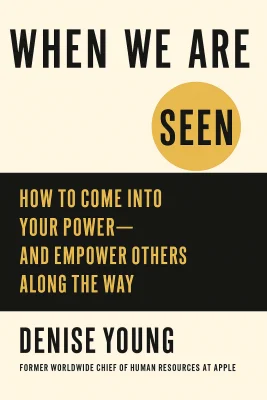
When We Are Seen
How to Come Into Your Power – and Empower Others Along the Way
Categories
Nonfiction, Self Help, Leadership
Content Type
Book
Binding
Hardcover
Year
2024
Publisher
Crown
Language
English
ASIN
0593239296
ISBN
0593239296
ISBN13
9780593239292
File Download
PDF | EPUB
When We Are Seen Plot Summary
Introduction
The night of the opening of the Apple Store on Fifth Avenue in New York, Denise Young Smith felt truly seen. It was May 19, 2006, and at 6 p.m. they opened the doors to hundreds of people who had been waiting since the night before. This iconic glass cube would become the first 24-hour Apple Store in the world, a landmark designed to transform how customers experienced technology. As the head of HR and talent for Apple Stores, Denise had been instrumental in creating the culture that would define this revolutionary retail concept. During the opening celebration, comedian Dave Chappelle approached Denise after being introduced to her as an important Apple executive. With a knowing smile, he simply asked, "Ah, sister, head of everything... how's that going?" His question carried layers of understanding that few others in the room could grasp. In that brief exchange, Chappelle acknowledged the weight and significance of Denise's presence as a Black woman in a position of power at one of the world's most influential technology companies. This moment of being truly seen has stayed with her, illustrating how rare and valuable such recognition can be, especially for those who frequently navigate spaces where they are the "first" or the "only." Through Denise's journey, we witness the power of seeing and being seen, the challenges of breaking barriers in corporate America, and the importance of bringing one's full authentic self to leadership.
Chapter 1: Early Years: Formation of a Seer
Growing up in Colorado Springs, Denise Young was a child who learned to observe and listen intently. Rather than talking, she absorbed the conversations of adults around her, developing an ability to see beneath the surface of interactions. In her family's home, she would witness discussions about the day-to-day injustices abundant for Black people in America only a few years beyond securing civil rights. The military town where she grew up exposed her to stories of indignities endured in a recently desegregated military, alongside tales of migration from the rural South. Her community included families who had inherited generational legacies of resources and achievement. They were sitting upon and surrounded by Native American landmarks, and Denise first learned of the existence of the American Black West, where Black cowboys were revered. The local NAACP offices were housed in a building with a popular barbershop, beauty shop, and Black art gallery. Around the city there were churches, a Black Elks Lodge, and Black mortuaries. From these conversations and community experiences, Denise processed the art of wit, the underlying pain behind humor, and the indignation that often came with forgiveness. She came to understand the enormity of what descendants of enslaved people bore, and the responsibility they had to show up every day for those who had walked before them. She learned that many things could be true about a person all at once - the deep inner lives that people opted not to project but also could not hide. This early training in observation shaped Denise's ability to see others, a skill that would become central to her leadership style. She developed an understanding that humans can hold many dimensions of complexity, and that if we choose to be observant, we can see more, understand more, and learn much. Through mere observation, she gained a better sense of how and when to offer grace, space, or time to others. These childhood experiences of watching people in their full complexity prepared her for a career in which seeing people holistically would become her superpower. Denise recalls specific women from her childhood church whom she called the "Smiling Sisters." They were always manicured and well-dressed, with glorious hats and bright lipstick. But most important was their smiles - glistening smiles that gleamed, beamed, and welcomed. Yet often these smiles did not match their somber regality but told a different story. Watching them in those childhood years honed her ability to see others, and to ultimately recognize herself.
Chapter 2: HBCU Experience and Cultural Foundation
When deciding where to go to college, Denise's uncle Frank sat her down for an important conversation. "Little girl," he said, "you need to go to a school where you will be educated on more than academics, where you will learn how to survive and thrive, and where you will make friends that will stay with you for the rest of your life." He was referring to Historically Black Colleges and Universities (HBCUs), specifically suggesting Dillard University in New Orleans or Grambling State University in Northern Louisiana. The majority of HBCUs were founded in the late nineteenth century, after the Emancipation Proclamation, to create higher-education experiences for newly freed Black citizens. These institutions were built for Black students who were unwelcome or excluded from existing universities. Today, 107 HBCUs produce 20 percent of all Black graduates and 25 percent of Black graduates in STEM fields. They represent educational excellence despite historical underfunding and systemic barriers. Denise ultimately chose Grambling State University, where she embraced the campus slogan—"Where Everybody Is Somebody." At Grambling, there were about four thousand students from diverse backgrounds - some from well-off families, others enduring significant hardship to find their place on campus. Despite these differences, they assembled to embark upon their idea of greatness together, and at Grambling, no one was lesser because of how they'd arrived there. One of Denise's pivotal moments came when Miss Lee Grant, a feared literature professor, announced she would be grading Denise on a higher curve than the rest of the class because it was "too easy" for her. This experience taught Denise that equity did not mean treating everyone equally; sometimes you had to treat people differently to set them up for the greatest success. This understanding would later influence her approach to leadership and diversity work at Apple. At Grambling, Denise took every class that caught her attention: molecular biology, ethics, public relations. She was delighted to be welcomed by Grambling's dance troupe, Orchesis, led with rigor and discipline by dancer Dr. Catherine Williams. Known for a soulful and graceful dance style, they became the first women allowed to "dance front" Grambling's famed Marching Tigers band, premiering at the first New Orleans-based Bayou Classic. The HBCU experience taught Denise that most students had potential for greatness, but many needed something more or different to help them get there. Each student had to be individually seen, heard, and understood to best enhance their gifts. Not all would receive the same kind of support or teaching approaches. This philosophy, if applied to corporate America, could be critical to the success of building diverse teams and assuring compelling outcomes.
Chapter 3: Rising at Apple: Breaking Glass Ceilings
Denise's journey with Apple began in Fountain, Colorado, when she heard the company had established a presence just ten miles south of where she was living. After interviewing, she was hired as a college and community recruiting specialist to help Apple acclimate and find good local talent in the Colorado community. The Colorado Apple site was the company's second largest production facility in the world, focused on physically building the products of its era: Power Macs and PowerBooks. When Apple divested the Colorado site in 1997, Denise received a call from Cupertino, offering her a new role in employee relations. This meant relocating her family to California - a huge decision. Following her intuition and seeing the potential to make a real difference, she made the move to Northern California. There, she was immediately welcomed by Black colleagues who were dialed in to a network of African American professionals in the area. In 1996, the Bay Area offered abundant opportunities for those savvy enough to be there. Between her newfound community of successful people of color and a welcoming artistic community, Denise knew she'd found her new extended home. What she did not know then was that Blacks had lived in, worked in, and contributed significantly to Silicon Valley for over half a century - a rich history that was not broadly known. After briefly leaving Apple during the dot-com boom, Denise returned in 2001 to direct employee relations worldwide. She saw the opportunity to positively impact how employees were seen and heard, helping build the kind of culture she'd always wanted to be a part of. She viewed employee relations not just as handling grievances and enforcing conduct, but as a voice and conduit to employees, a barometer of healthy culture. Denise was in her ER role for only a year when the senior vice president of HR, Dan Walker, tapped her for what would become a massive ground-up effort to build out the soon-to-be-revealed Apple Stores. Despite her initial hesitation due to lack of retail experience, Dan told her, "You know people and you know culture, and you know it better than anyone else that we've met or that we know inside of the company, period, bar none." This recognition of her unique skills marked a turning point in her career, setting her on a path to create a revolutionary retail experience centered on seeing people.
Chapter 4: Creating the Apple Store Culture
When tasked with building the Apple Store culture, Denise understood that if the company wanted to create enriched customer engagement, it would be achieved through employees who were fully realized in their roles. The Apple Stores couldn't expect thousands of employees to touch millions of customers in a casual or inauthentic way. If employees felt diminished or undervalued, that feeling would transfer directly to the customer experience. To perpetuate a seeing, thriving culture, Denise and her team created a document containing a credo of commitments. The commitments were to uphold the vision of Apple products, strive to enrich the lives of customers, and protect the resource they deemed most important: people. One of the earliest versions stated: "At Apple our most important resource, our soul, is our people. We value dynamic, intelligent, and interesting people who are passionate about Apple. We offer a stimulating work environment, designed to create unparalleled career experiences and develop lifelong skills." While these types of manifestos can be found in many organizations, there was something authentic that resonated with people around these statements. The document was not authored by a PR department, but by a collective representation of employees from every corner of the retail business. It felt human, and was treated not as a mandate but as inspiration to a north star that illuminated the path to thriving. Denise believed that empathy was essential for creating a human-focused culture. She observed that the most successful Store leaders used a different language, modeled authenticity, and applied empathy. They understood being present and took the time to do so, remaining attuned to their teams across different regions and markets. Under her leadership, the Store teams prioritized humanity while still driving successful business outcomes. She insisted these concepts should not be separate, but inseparable. For any company that didn't start with humanity prioritized, Denise believed empathy was a must-have skill for organizations to navigate the slow, deliberate, soul-level work of shifting to a human-focused culture. Empathy counterintuitively creates more space and time, as it collects perspective that can be readily deployed when needed. Managers who see and know more about their teams are better placed to address human issues when they arise.
Chapter 5: Challenges of Being a First and Only
Throughout her career at Apple, Denise experienced the unique challenges of being a "first" and an "only." She had only one Black boss in her entire professional career, which meant working predominantly with people who didn't share her lived experience or background. While her colleagues often viewed her success as an accolade, they rarely registered the added complexities she faced compared to her white male counterparts. The experience of being unseen was common for women of color in technology. Denise noted that her colleagues celebrated her achievements but held little awareness of the fact that there were few "others" like her, although there were many like them. They were cognizant of the circumstances of their own paths to achievement but held little awareness of the added complexities of hers. In meetings, Denise often observed her suggestions being overlooked until a white male colleague repeated them. She noted how her approach to leadership - leading with empathy and focusing on people - was frequently characterized as "too soft" or "too nice" in environments that valued traditionally masculine traits. When she raised issues about representation or diversity, she faced resistance from colleagues who viewed such concerns as "distractions" from business priorities. Throughout her time at Apple, Denise carried the additional burden of representation. As one of the few Black executives at the company, she was often expected to speak for all Black employees and to serve as the face of diversity efforts. This responsibility added pressure to her already demanding role and created a constant tension between her authentic self and the expectations placed upon her by the organization. Despite these challenges, Denise remained committed to her values and vision. She recognized that her presence at Apple was meaningful not just for her personal career, but for what it represented to others who might follow. When she entered rooms representing Apple as a Black female executive, if there was a person of color present, something ignited in them - perhaps hope, optimism, pride, or comfort. Her visibility mattered, even when the systems around her failed to fully see her.
Chapter 6: The Power of Empathy in Leadership
For Denise, empathy was not a "squishy" concept but a strategic advantage in leadership. However, she observed that in business settings, empathy was often misunderstood as "being nice" rather than as an essential skill for the twenty-first century. Many business leaders resisted demonstrating empathy for fear they might be mistaken for nice, polite, comforting, or supportive - qualities often devalued in corporate settings. When running employee relations at Apple, Denise was renowned for her ability to hear everyone's side of a story. She was intent on probing for the "why" behind situations, because understanding root causes typically revealed the very reasons conflicts had emerged in the first place. However, she frequently encountered resistance to this approach, as it made room for unearthing uncomfortable truths that many preferred to remain undiscussed. During her time leading teams for the Apple Stores, Denise implemented the Net Promoter System not just for customers but also for employees. This allowed staff to express how they truly felt about their work experience. When the system launched, several Black employees reached out to her asking, "Is this real? Can I really say what I am thinking, and not get into trouble?" Their questions revealed a deeper concern about safety and trust that other employees might not have experienced to the same degree. Denise noted that empathy in the workplace often carries additional tolls and taxes for people of color. As one of the few Black executives at Apple, she served as an explainer, question answerer, representative, quiet mentor, assurer, and decoder for many employees. Until there is broader representation inside companies, the highest level managers or thought leaders who are from underrepresented groups are arguably some of an organization's most precious resources, and must be cared for accordingly. In her Cornell Tech residency, Denise presented empathy as the new "hard" skill, essential in developing technology that engages humanly. She observed that after the global pandemic, eyes seemed to have opened to the fact that in every possible area, more humanity is needed - absolutely more empathy, but also more permission to exert our humanness in the workplace and beyond.
Chapter 7: Finding Voice: Personal and Professional Authenticity
Throughout her career, Denise constantly navigated the tension between her authentic self and professional expectations. As a Black woman in predominantly white spaces, she developed expertise in code-switching - adapting her language, appearance, and behavior to fit different contexts. She described effective code-switching like a smoothly executed vocal passaggio, moving up or down vocal registers with no discernible transition. Her hair became a particular focal point of this tension. For Black women, hair is existential and deeply cultural. Denise would change her hairstyle based on her mood, shifting between styles, colors, extensions, wraps, cuts, twists, and locs. With each change came predictable questions and comments from coworkers: "How long did that take?" "Does it hurt?" "It makes you look so different!" These interactions represented microaggressions that, in aggregate, created an emotional toll. Beyond physical appearance, Denise also had to navigate voice and expression. In her early working years, she was frequently told she had "potential," but noticed that her male colleagues appeared to be skipping the "potential" step and moving straight to "promotable" and "promoted." When she asked what constituted "promotable" for her, she was told she was "more people-oriented than business-oriented" or "really smart, but too soft-spoken" as male colleagues talked over and interrupted her. In 2017, a pivotal moment came when Denise spoke at the One Young World conference in Bogotá. During a panel on diversity, she made a comment about how diversity includes everyone's unique perspectives, including "twelve white blue-eyed blond men in a room." Her words were taken out of context by media outlets, creating a social media firestorm. This experience taught her the importance of owning and protecting her own story. She had been so focused on seeing and advocating for others that she had taken her own narrative for granted. The stress of this incident manifested physically - Denise lost her voice completely. A voice doctor told her, "There is something serious going on in your head and likely your heart, and this must be addressed, because a singer needs these faculties to be able to function." Through a process of healing and reflection, Denise gradually recovered her voice, both literally and metaphorically. She realized that her voice was "the voice of my ancestors speaking their truth into the future" and vowed to cherish and steward it. After more than twenty years at Apple, Denise left to pursue a Cornell Tech residency and other creative endeavors. She found freedom in reclaiming her voice and telling her own story on her own terms. Her journey taught her that when we are seen, it is often a reverse roadmap of cues that unfolded throughout our lives - moments that inform who we are at a very core level.
Summary
Denise Young Smith's journey illuminates a profound truth: the power of seeing and being seen is a force that can transform lives and organizations. As a Black woman who rose to C-level leadership at Apple, she navigated the complex terrain of being a "first" and "only" while staying true to her core values of empathy, authenticity, and human connection. Her approach to leadership centered on seeing people holistically - their struggles, their potential, their full humanity - and this vision helped create the revolutionary Apple Store culture that changed retail forever. The lessons from Denise's story extend far beyond corporate leadership. They speak to anyone who has felt unseen, anyone striving to bring their authentic self to their work, and anyone with the power to see others more fully. In a world increasingly dominated by technology and artificial intelligence, her emphasis on human connection reminds us that seeing each other - truly seeing - is both our greatest challenge and our greatest opportunity. When we meet ourselves and others where we are, with empathy and understanding, we create spaces where everyone can thrive. This is not merely a diversity initiative or corporate strategy; it is a fundamental human imperative that allows us to connect, to create, and ultimately to transform our world through the simple yet profound act of seeing one another.
Best Quote
Review Summary
Strengths: The review highlights Denise Young's ability to provide a fresh perspective on leadership, moving beyond common platitudes. Her diverse background enriches her insights, and she effectively argues for the importance of genuine visibility and representation in leadership. Weaknesses: Not explicitly mentioned. Overall Sentiment: Enthusiastic Key Takeaway: Denise Young's "When We Are Seen" emphasizes the significance of being genuinely valued for one's unique contributions and identity in leadership, advocating for true visibility and representation as essential components of impactful leadership.
About Author

Denise Young
Young interrogates the complexities of empowerment and leadership through her insightful work, reflecting a profound commitment to fostering inclusivity in professional environments. Her book, "When We Are Seen: How to Come Into Your Power—and Empower Others Along the Way," serves as both a practical guide and a motivational discourse, offering readers strategies to realize their potential while supporting the growth of others. By weaving together her extensive experience at Apple, where she broke barriers as the company's first Black chief of human resources and vice president of inclusion and diversity, with her role as an executive-in-residence at Cornell Tech, Young provides a unique perspective on creating equitable environments.\n\nIn her writing, Young focuses on the themes of personal and communal strength, exploring how individuals can navigate the intricacies of leadership and diversity. She presents a compelling case for why inclusive practices are essential, employing a blend of clarity and depth that makes her work accessible and engaging. Her method emphasizes the interplay between self-empowerment and collective upliftment, offering practical strategies for transformative leadership. This approach not only benefits those in leadership roles but also resonates with anyone striving for personal and professional growth.\n\nYoung's recognition by Black Enterprise and Ebony as one of the "Most Powerful Women" and as a part of the "Power 100" underscores her influence as a thought leader. Her contributions go beyond the corporate realm, influencing the ongoing dialogue on diversity and empowerment. Therefore, her book is an invaluable resource for readers looking to engage deeply with the challenges and opportunities of creating dynamic and inclusive environments. Through her work, Young emerges not only as an author but as a crucial voice advocating for organizational change and empowerment across various sectors.
Read moreDownload PDF & EPUB
To save this Black List summary for later, download the free PDF and EPUB. You can print it out, or read offline at your convenience.
When We Are Seen
by Denise Young
