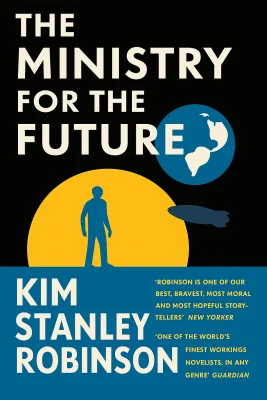
The Ministry for the Future
Categories
Fiction, Politics, Science Fiction, Audiobook, Science Fiction Fantasy, Book Club, Environment, Speculative Fiction, Climate Change, Climate Change Fiction
Content Type
Book
Binding
Hardcover
Year
2020
Publisher
Orbit
Language
English
ASIN
0316300136
ISBN
0316300136
ISBN13
9780316300131
File Download
PDF | EPUB
The Ministry for the Future Plot Summary
Introduction
# The Ministry for the Future: Earth's Last Guardians The heat struck India like a furnace door swinging open. Frank May pressed his face against the window of the relief station, watching the thermometer climb past fifty degrees Celsius as the sun rose over Uttar Pradesh. The wet-bulb temperature—that deadly combination of heat and humidity—had crossed the threshold where human bodies simply cannot cool themselves. Around him, people were dying faster than they could be counted. Twenty million would perish in the coming days, their bodies cooked from within by air that had become unbreathable. This catastrophe would birth something unprecedented: the Ministry for the Future, a small UN agency tasked with defending the rights of generations yet unborn. Led by Irish diplomat Mary Murphy from a modest office in Zurich, this unlikely organization would find itself at the center of humanity's last desperate gambit to save itself from climate collapse. But as temperatures soared and the old world crumbled, the ministry would discover that salvation might require embracing methods that would have horrified their former selves.
Chapter 1: The Heat That Broke the World: India's Twenty Million
Frank May stumbled through the relief camp as bodies dropped around him like stones. The American aid worker had arrived in Uttar Pradesh expecting to distribute water and medical supplies. Instead, he found himself witnessing the first mass extinction event in human history caused purely by heat. The children went first. Their small bodies couldn't regulate temperature as efficiently as adults, and they simply overheated like broken machines. Frank watched a mother carry her unconscious daughter toward the medical tent, the child's skin burning to the touch. By the time they reached the doctor, the girl was gone. The power grid had collapsed under the demand for air conditioning, leaving millions without relief from the killing heat. Even the hospitals were running on failing generators. Frank's colleague Dr. Patel worked frantically to save lives, but there was no treatment for what was happening. Human physiology had limits, and those limits were being exceeded across an entire subcontinent. "Get to the lake," people shouted, but when Frank reached the water, he found it as warm as a bath. Thousands of people stood neck-deep in the tepid lake, holding umbrellas against the sun, their faces red with heat exhaustion. The lucky ones had found space under the few trees. The unlucky simply lay where they fell. Frank pressed himself against the concrete shore, half-submerged, watching satellites pass overhead like distant stars. Someone up there knew what was happening. The whole world was watching twenty million people die, and no one could do anything to stop it. The heat had revealed something terrible about the planet they lived on: it was no longer safe for human life. When rescue helicopters finally arrived three days later, Frank was found sitting motionless beside the lake, the sole survivor of his town. The trauma had carved itself so deeply into his mind that he would spend the next decade haunted by visions of children's faces and the sound of mothers screaming for help that would never come.
Chapter 2: Birth of the Ministry: Defending the Voiceless Future
Mary Murphy stood before the emergency session of the UN General Assembly, her Irish accent cutting through the diplomatic murmur like a blade. Behind her, satellite images showed the scope of the Indian catastrophe: entire cities gone silent, refugee camps overflowing with survivors, mass graves stretching beyond the horizon. "Twenty million people died in three days," she announced to the assembled delegates. "More than the entire First World War, compressed into a single heat wave. The stain of such a crime will never wash away." The great hall fell silent with the weight of collective shame. Every nation had signed the Paris Agreement. Every nation had failed to meet its promises. From this catastrophe, the Ministry for the Future was born. Article 16 of the Paris Agreement allowed for new subsidiary bodies, and the desperate delegates created one with unprecedented scope: to defend the rights of future generations and all creatures that cannot speak for themselves. It was humanity's admission that normal politics had failed. Mary found herself appointed to lead this impossible mission from a modest office above a Zurich tram stop. Her budget was sixty billion dollars against a global economy of one hundred trillion. Her mandate was to save the world. Her tools were lawsuits, publicity campaigns, and moral suasion. Her deputy, Badim Bahadur, arrived from Nepal with eyes that held secrets and a mind that worked in ways Mary didn't fully understand. A former revolutionary, he spoke softly but carried himself like someone who had seen violence and wasn't afraid of it. When Mary asked about his background, he simply said he had worked in "conflict resolution" and changed the subject. Standing in her office overlooking the Swiss city, Mary understood the mathematics of failure. The ship was going down, the parasite was killing its host. She had been given a teaspoon to bail out the Titanic. But as Badim would soon remind her, there were other ways to fight than the ones written in diplomatic handbooks. The question was whether she had the courage to use them.
Chapter 3: Children of Kali: When Desperation Breeds Revolution
The container ships began vanishing on a Tuesday morning. Forty vessels in six months, disappeared from the world's shipping lanes without distress signals or wreckage. Maritime authorities assumed accidents until the pattern emerged: only the largest cargo carriers were being targeted, the backbone of global trade that burned the dirtiest fuel and carried the most carbon-intensive goods. Frank May, now living in a psychiatric facility in Switzerland, watched the news with hollow recognition. The heat wave had broken something fundamental in his mind, leaving him floating between rage and numbness. When investigators spoke of "unknown actors using advanced drone technology," Frank understood what they couldn't say: the planet was fighting back. The attacks escalated with surgical precision. Private jets fell from the sky, brought down by swarms of micro-drones that clogged their engines. Oil executives died in their penthouses, victims of missiles too small to track. Coal plants suffered mysterious explosions that investigators couldn't explain. Someone had declared war on the fossil fuel economy, and they were winning through pure terror. No one claimed responsibility, but whispers spoke of the Children of Kali, named for the Hindu goddess of destruction and renewal. They followed strict rules of engagement: no innocent casualties, no collateral damage. Only those who knowingly profited from planetary destruction would face their judgment. The guilty tried to dismiss them as terrorists, but Kali was fair and meticulous, they said. Justice incarnate. Mary found herself in an impossible position. Officially, the Ministry condemned all acts of violence. Privately, she couldn't ignore the results. Global shipping had been forced to retrofit with clean energy systems virtually overnight. Aviation ground to a halt except for electric aircraft. The stock market hemorrhaged value as investors realized that carbon-burning infrastructure had become a death sentence. When Mary finally confronted Badim about the ministry's possible involvement, he looked at her with something approaching pity. "You gave me a mandate to protect future generations by any means necessary," he said quietly. "Did you think that would only involve filing reports and attending conferences?" The shadow war was accelerating, and Mary was beginning to understand that her willful ignorance made her complicit in something far larger than she had imagined.
Chapter 4: The Reckoning: Trauma Confronts Power
Frank May stepped out of the Zurich shadows like a ghost returning from the dead. His wild eyes burned with desperate conviction as he approached Mary Murphy walking home from dinner. The plastic restraint clicked around her wrist like a death sentence, and the gun in his other hand made refusal impossible. "I want to talk with you," he said, pulling her through the dark streets toward her own apartment. Mary's heart hammered as she realized she was being kidnapped by a man who had survived the unsurvivable, whose mind had been shattered by witnessing twenty million deaths. In her own kitchen, Frank paced like a caged animal, his face flushing red with remembered heat. "It's going to happen again," he said, his voice strangled with barely controlled fury. "Because nothing's changed. The same people who killed twenty million are still in power. Why do you pretend not to know?" Mary tried to maintain diplomatic calm, but Frank's intensity was overwhelming. He had felt the heat that would kill millions more unless someone found the courage to act. "You're not doing everything you can," he accused. "There's more you could be doing. If you were serious, you'd have a black wing, doing things outside the law to accelerate change." The confrontation lasted hours, two damaged people circling each other in a dance of accusation and recognition. Frank had been broken by witnessing mass death. Mary was being broken by her inability to prevent it. They were both casualties of a war most people didn't even know was being fought. "The law is allowing the very violence you're opposed to," Frank continued, his words hitting like physical blows. "Every day you follow the rules, more people die. Every conference you attend, every report you file, children are burning alive in heat waves that could be prevented." When police sirens finally wailed outside, Frank vanished into the night like smoke. But his words remained, burning in Mary's mind like brands. She understood now why Badim had been keeping secrets, why desperate people were taking desperate measures. The ministry's official tools weren't enough. To save the future, they would need to embrace the darkness that Frank had shown her.
Chapter 5: The Carbon Coin: Rewriting Economics for Survival
Mary Murphy sat across from the world's most powerful bankers in San Francisco's gleaming tower, watching their faces close like shutters as she explained the carbon coin proposal. The Federal Reserve chair, Jane Yablonski, delivered the death blow with bureaucratic precision: "We exist to protect the dollar, nothing else. This isn't our purview." But the bankers were scared. Climate disasters were multiplying faster than their risk models could calculate. Entire regions were becoming uninhabitable, making their investments worthless. The old economy was eating itself alive, consuming the biosphere that sustained it. They needed a new foundation before the whole system collapsed. The carbon coin would be simple: one coin for every ton of carbon kept out of the atmosphere. Central banks would guarantee its value, making it the safest investment in a world where nothing else was safe. Farmers who rebuilt soil carbon would earn coins. Companies that captured emissions would be rewarded. Nations that preserved forests would be paid. Mary watched the bankers debate with mixture of amazement and skepticism. These were the same people who had resisted climate action for decades, and now they were proposing to restructure the entire global economy around carbon reduction. The climate crisis had shattered old assumptions and made the impossible inevitable. When Arabia's new government offered to keep their oil in the ground in exchange for carbon coins, the dam broke. Brazil followed, then others. Suddenly, not burning carbon became more profitable than burning it. The market had found its new god, and its name was survival. The carbon coin launched six months later, backed by every major central bank on Earth. The results were immediate and dramatic. Atmospheric carbon dioxide levels began falling for the first time in human history. Reforestation projects sprouted across continents as communities raced to earn the new currency. Direct air capture facilities multiplied like mushrooms after rain. But the real revolution came when the central banks used their new power to reshape society itself. Maximum wage ratios capped executive compensation. Universal basic services guaranteed housing and healthcare. The old economy of endless growth and inequality began to crumble, replaced by something that prioritized human welfare over abstract financial metrics. Frank May, watching from his small apartment, felt something he hadn't experienced since India: hope.
Chapter 6: Half Earth Rising: Technology and Rewilding Unite
The wolves returned to Yellowstone first, then spread outward like ripples across the American West. Mary Murphy stood in a Montana meadow, watching a pack hunt elk while their human escorts tracked their movements with GPS collars. This was the Half Earth project in action: returning vast swaths of the planet to wild animals while relocating human populations to more sustainable communities. The town of Wisdom, Montana, had voted to accept a buyout that would make every resident financially secure for life in exchange for abandoning their homes to the returning wilderness. It was happening across rural America as climate change and economic collapse made small-town life increasingly untenable. "Most of these communities were dying anyway," explained Sarah Chen, the project coordinator. "The young people had already left for the cities. We're just making the transition easier and giving the land back to its original inhabitants." Within five years of human withdrawal, wildlife populations had exploded. Bison herds thundered across prairies that had been wheat fields just decades before. Meanwhile, in the Antarctic wasteland, glaciologist Pete Griffen watched his team drill through nine hundred meters of ice to reach the hidden ocean beneath. The Thwaites Glacier was sliding toward the sea, lubricated by meltwater that had turned solid ice into a massive water slide. If they could pump out that water, they might slow the glacier's death march. The physics were daunting. Each centimeter of sea level rise represented thirty-six hundred cubic kilometers of water. The infrastructure required would dwarf any human project in history. But the alternative was watching coastal cities drown as ice sheets collapsed into the ocean. In the Arctic Ocean, fleets of autonomous vehicles sprayed seawater onto thinning ice, trying to thicken it enough to survive the summer sun. Millions of tiny robots drilled and pumped and sprayed, each one a desperate attempt to preserve the white mirror that reflected sunlight back to space. Mary found herself thinking of Frank May as she watched the wolves. He had always been drawn to wild animals, finding in them a peace that human society couldn't provide. The rewilding wasn't just about animals—it was about rewilding humanity itself, reconnecting people with the natural systems that had sustained their ancestors for millennia. They were performing surgery on a patient they barely understood, but for the first time since the Indian heat wave, the future looked brighter than the past.
Chapter 7: The Quiet Revolution: Institutions Transform from Within
The revolution came not with violence but with spreadsheets. In boardrooms and government offices around the world, a quiet transformation was reshaping the fundamental structures of power. The carbon coin had done more than incentivize environmental protection—it had created a new form of money that couldn't be hidden in tax havens or manipulated by financial speculators. Every transaction was recorded on a blockchain visible to all, making corruption and tax evasion nearly impossible. Wealth inequality, which had reached obscene levels in the early 21st century, began to flatten as maximum wage ratios and progressive taxation redistributed resources more fairly. Frank May didn't live to see the full transformation. Mary had been with him in his final days, sitting beside his hospital bed as a brain tumor slowly claimed his brilliant, tormented mind. In his lucid moments, he spoke of the animals he had seen in the Alps, the chamois and marmots that had shown him a different way of being in the world. The memorial service was small but meaningful. Representatives from refugee organizations spoke of Frank's work in the camps, his dedication to helping climate migrants find new homes. Mary delivered the eulogy, speaking of his courage in bearing witness to humanity's darkest hour and his role in inspiring the changes that followed. The institutional changes were accelerating. The European Union had implemented maximum wage ratios. China had restructured its economy around environmental restoration rather than endless growth. Even the United States had begun experimenting with universal basic services funded by carbon taxes. Mary prepared to step down from her position, confident that the ministry's work would continue. The crisis wasn't over—it would take decades to fully stabilize the climate and repair the damage done by centuries of fossil fuel burning. But the trajectory had changed. Humanity was no longer racing toward extinction but climbing slowly toward a sustainable future. The carbon coin had succeeded beyond anyone's wildest dreams, creating incentives that had transformed the global economy in less than a decade. Atmospheric carbon dioxide levels were actually falling, dropping from a peak of 475 parts per million and continuing to decline. The worst-case scenarios had been avoided, and the planet was slowly beginning to heal.
Chapter 8: Seeds of Tomorrow: Healing in a Wounded World
Mary Murphy's retirement began with a voyage across the Atlantic on a wind-powered clipper ship. The vessel was a marvel of technology, its photovoltaic sails capturing both wind and sunlight to power electric motors. She spent the eight-day journey working at her laptop in the morning and walking the deck in the afternoon, watching dolphins race alongside the hull. She was traveling to witness the formal adoption of the carbon coin as the world's reserve currency. It was a moment that would have been unimaginable just a decade earlier, but the climate crisis had shattered old assumptions and made the impossible inevitable. The meeting in San Francisco was both triumphant and sobering. The carbon coin had succeeded beyond anyone's wildest dreams, but the human cost had been enormous. Millions had died in heat waves, floods, and storms. Entire nations had been forced to relocate as sea levels rose and deserts expanded. Mary's final act as minister was to attend the Conference of Parties meeting in Zurich, where world leaders gathered to take stock of their progress. The mood was cautiously optimistic. The worst-case scenarios had been avoided, and the planet was slowly beginning to heal. But vigilance would be required for decades to come. On her last night in office, Mary walked along the shores of Lake Zurich, thinking of all the people who hadn't lived to see this moment. Frank May, whose trauma had opened her eyes to the true cost of inaction. The twenty million victims of the Indian heat wave, whose deaths had finally shocked humanity into action. The lake was calm, reflecting the lights of the city like scattered stars. In the distance, the Alps rose against the night sky, their peaks crowned with snow that would endure for centuries thanks to the geoengineering projects that had stabilized the climate. It was a beautiful sight, but Mary knew that beauty had been purchased with immense suffering. As she prepared to begin the next chapter of her life, Mary felt a profound sense of both accomplishment and humility. They had saved the world, but the world had also saved itself, through the actions of countless individuals who had chosen hope over despair, cooperation over competition, and the future over the past. The seeds of a new world had been planted in the ashes of the old, and now it was time to tend them with the same fierce dedication that had made their survival possible.
Summary
The Ministry for the Future began as a bureaucratic afterthought and ended as the catalyst for humanity's greatest transformation. Through the intertwined stories of Mary Murphy and Frank May, we witness how personal trauma and institutional power combined to reshape civilization itself. Frank's suffering in the Indian heat wave became the moral foundation for a revolution that touched every aspect of human society, while Mary's pragmatic leadership provided the framework for change that once seemed impossible. The carbon coin proved to be more than just a new currency—it was a tool for rewriting the rules of power itself. By making environmental protection profitable and carbon burning expensive, it created incentives that transformed everything from agriculture to international trade. The Half Earth project returned vast territories to wildlife, while new forms of democratic ownership replaced the extractive capitalism that had driven the planet to the brink of collapse. Yet the victory came at an enormous cost, measured not just in the millions who died in climate disasters but in the psychological trauma that scarred an entire generation. The world that emerged was more just and sustainable than its predecessor, but also haunted by the knowledge of how close humanity had come to extinction. In the end, the Ministry succeeded not because it found easy solutions to impossible problems, but because it dared to imagine that the future could be different from the past—and then made that imagination real through the accumulated choices of billions of people who refused to surrender hope in the face of overwhelming darkness.
Best Quote
“To be clear, concluding in brief: there is enough for all. So there should be no more people living in poverty. And there should be no more billionaires. Enough should be a human right, a floor below which no one can fall; also a ceiling above which no one can rise. Enough is as good as a feast—or better.” ― Kim Stanley Robinson, The Ministry for the Future
Review Summary
Strengths: The book occupies a unique space between fiction and non-fiction, offering a blend of personal stories and detailed geoengineering techniques. It fosters hope and imagination for climate solutions, and is described as brave, fast-paced, and subdued. The novel is seen as a synthesis and departure from the author's previous works, and is unapologetically true to the author's style. Weaknesses: Some may perceive it as not enough of a novel, potentially boring or preachy. The review hints at a possible criticism regarding the author's approach, though it is not fully articulated. Overall: The reader expresses a positive sentiment, appreciating the book's hopeful and imaginative approach to climate change. It is recommended as a rallying cry for optimism and action, despite potential cynicism.
About Author

Kim Stanley Robinson
Robinson interrogates the potential of science fiction as a powerful literary form by embedding ecological, cultural, and political themes into his work. His narrative style often features scientists as protagonists, offering a humanist perspective on speculative futures. Unlike many of his contemporaries, Robinson eschews dystopian tropes, preferring instead to explore utopian scenarios, as exemplified in his acclaimed book "The Ministry for the Future". This work represents a "best case scenario that you could still believe in," carefully balancing optimism and realism. His Orange County trilogy, for instance, delves into alternative futures for Southern California, reflecting his interest in environmentalism and human resilience.\n\nRobinson’s contributions have significantly impacted readers and the broader literary community. His approach to "literary science fiction" challenges traditional genre boundaries, making his work appealing to both science fiction enthusiasts and literary fiction readers. The bio of this author is enriched by his prolific career, having published 22 novels, including the internationally bestselling "Mars" trilogy. Recognition for his contributions includes numerous prestigious awards such as the Hugo, Nebula, and World Fantasy Awards. In 2016, he received the Heinlein Award for lifetime achievement, solidifying his status as one of the foremost figures in science fiction. For those seeking thought-provoking narratives that connect scientific inquiry with humanistic values, Robinson’s books offer a compelling exploration of possible futures.
Read moreDownload PDF & EPUB
To save this Black List summary for later, download the free PDF and EPUB. You can print it out, or read offline at your convenience.
The Ministry for the Future
by Kim Stanley Robinson
